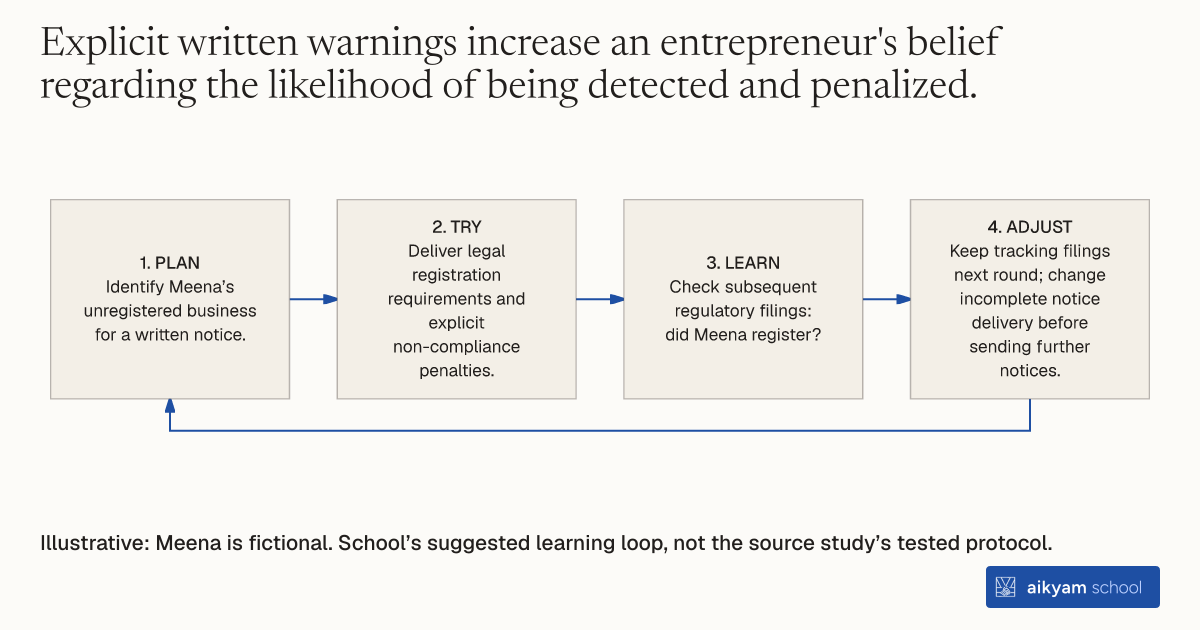
Try, learn and adjust
Check registration after written notices
- Plan: Identify Meena’s unregistered business for a written notice.
- Try: Deliver legal registration requirements and explicit non-compliance penalties.
- Learn: Check subsequent regulatory filings: did Meena register?
- Adjust: Keep tracking filings next round; change incomplete notice delivery before sending further notices.
Illustrative: Meena is fictional. School’s suggested learning loop, not the source study’s tested protocol.
See source →School’s suggested, untested loop. Observe notice delivery and subsequent registration filings; no registration increase is assumed.
How
When to use
Informal enterprise owners often operate outside the legal system because they perceive the probability of legal sanctions as negligible. This situation reduces tax compliance and government authority over small business activity. It applies to municipal authorities and regulatory agencies seeking to increase firm formalization without conducting expensive in-person inspections.
Send targeted written notifications to informal business owners stating legal registration requirements and non-compliance penalties.
- Identify unregistered micro-enterprises operating within municipal boundaries.
- Draft official written notices specifying the mandatory legal registration requirements for small businesses.
- Include explicit details outlining the legal and financial consequences of failing to complete registration with competent authorities.
- Deliver the written notifications directly to target informal business owners.
- Track subsequent business registration filings with regulatory bodies.
Why it works
Raising the perceived cost of remaining informal encourages business owners to register voluntarily.
Example
In Bangladesh, researchers sent informal firms official notifications detailing registration mandates and non-compliance penalties, which successfully increased the proportion of registered businesses.
Source
See source →Evidence in Labor Market Policies and Implications for Brazil: Informality
Copyright © 2025 Inter-American Development Bank.
Full source notice
Copyright © 2025 Inter-American Development Bank ("IDB"). This work is subject to a Creative Commons license CC BY 3.0 IGO (https://creativecommons.org/licenses/by/3.0/igo/legalcode). The terms and conditions indicated in the URL link must be met and the respective recognition must be granted to the IDB. Further to section 8 of the above license, any mediation relating to disputes arising under such license shall be conducted in accordance with the WIPO Mediation Rules. Any dispute related to the use of the works of the IDB that cannot be settled amicably shall be submitted to arbitration pursuant to the United Nations Commission on International Trade Law (UNCITRAL) rules. The use of the IDB's name for any purpose other than for attribution, and the use of IDB's logo shall be subject to a separate written license agreement between the IDB and the user and is not authorized as part of this license. Note that the URL link includes terms and conditions that are an integral part of this license.