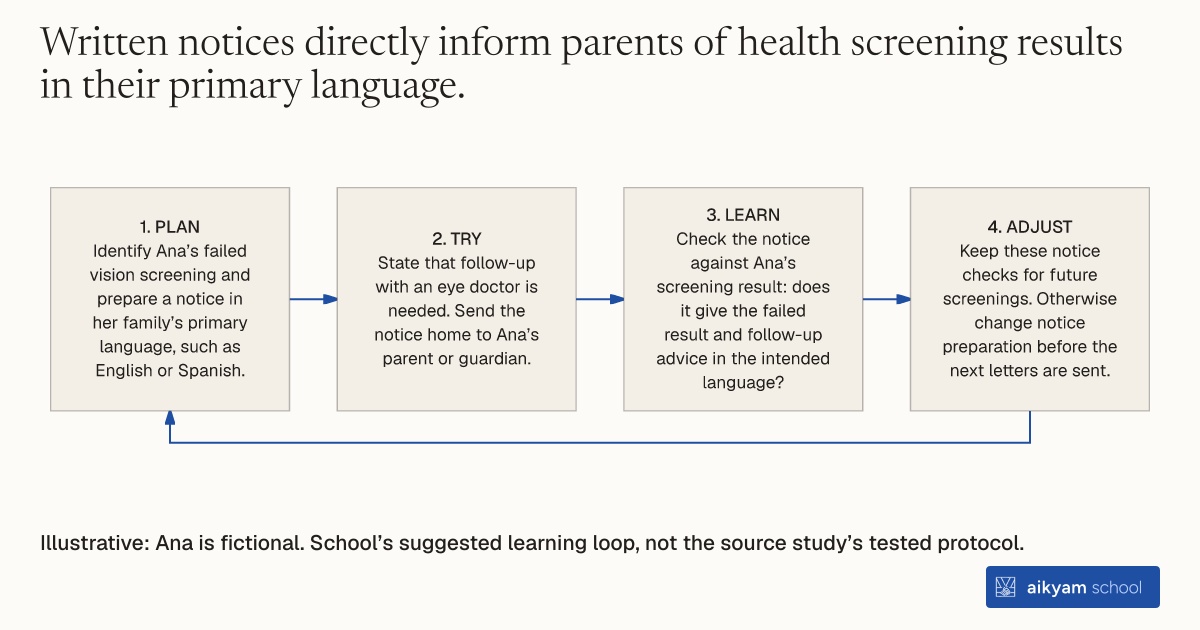
Try, learn and adjust
Check vision notices match screening results and language
- Plan: Identify Ana’s failed vision screening and prepare a notice in her family’s primary language, such as English or Spanish.
- Try: State that follow-up with an eye doctor is needed. Send the notice home to Ana’s parent or guardian.
- Learn: Check the notice against Ana’s screening result: does it give the failed result and follow-up advice in the intended language?
- Adjust: Keep these notice checks for future screenings. Otherwise change notice preparation before the next letters are sent.
Illustrative: Ana is fictional. School’s suggested learning loop, not the source study’s tested protocol.
See source →School’s suggested learning loop, not a source-tested procedure. Observe failed-screening notices and follow-up advice. Notification alone produced no statistically significant maths or reading gains.
How
When to use
Low-income elementary school students often have undetected vision problems that go untreated without parent awareness. Sending written notification letters to parents informs families when a child fails a school vision screening. This encourages parents to seek follow-up care with an outside eye doctor.
Notify parents in writing when their child fails a vision screening to prompt follow-up eye care.
- Identify students who fail digital auto-refraction vision screenings in school classrooms.
- Prepare written notification forms in the primary languages spoken by student families, such as English or Spanish.
- Indicate on each form that the student failed the screening and requires a follow-up exam with an eye doctor.
- Send the written notice home with each student directly to their parent or guardian following the screening date.
Why it works
This attempts to solve the information problem regarding undetected vision impairments.
Example
A non-profit sent written notices in English or Spanish to parents of students who failed vision screenings in screen-only Title 1 elementary schools across central Florida, instructing parents to seek follow-up care with a doctor of their choice.
About the study
Participants
1,885 fourth and fifth grade students in screen-only Title 1 elementary schools across central Florida, where over 70% of students qualified for free or reduced-price lunch.
Study Design
School-level randomized controlled trial evaluating the screen-only intervention (written parental notification only) against control schools using FCAT test score panels.
Results
Written parental notification alone failed to produce statistically significant academic gains in math or reading, demonstrating that providing information without free access to eye care does not resolve vision treatment barriers.