In Simple Words
Imagine trying to rebuild a house's upper floor (finding a job) while the ground floor lacks walls or support pillars (mental health, digital access, housing stability). Providing comprehensive gender-focused counseling acts like installing sturdy foundational pillars first, giving mothers the stability and confidence needed to build toward employment.
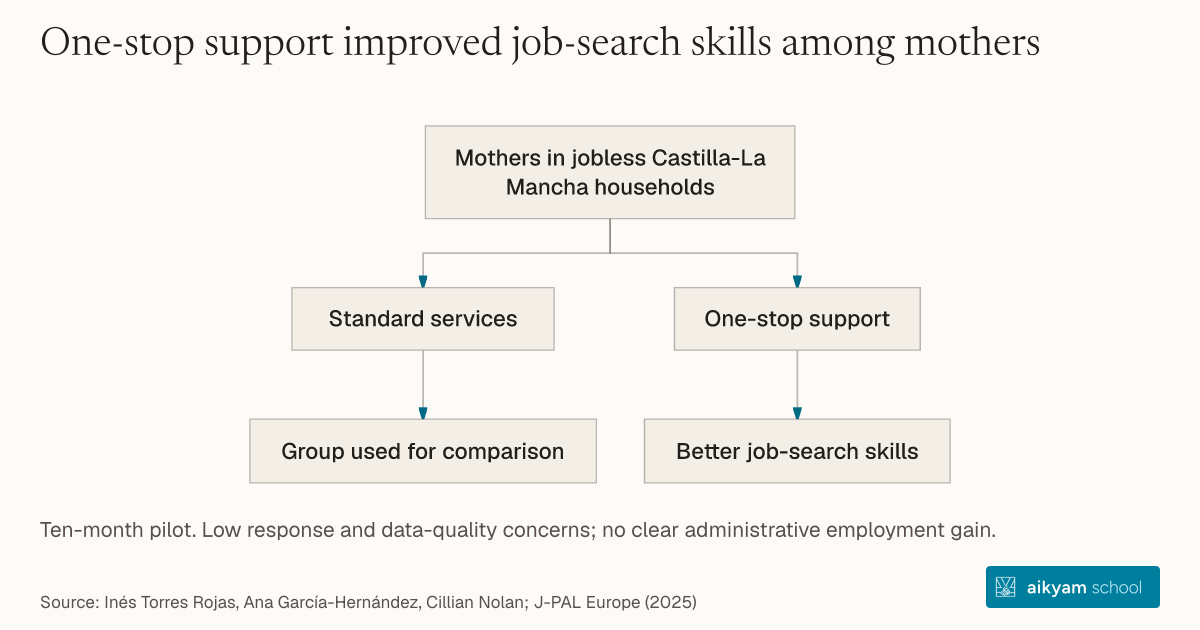
Mothers in jobless Castilla-La Mancha households
- Standard services
- Group used for comparison
- One-stop support
- Better job-search skills
Ten-month pilot. Low response and data-quality concerns; no clear administrative employment gain.
See source →Research question
Unemployed mothers in jobless households receiving minimum income face compounded gendered care burdens, social isolation, and low labor market attachment that standard public employment services fail to alleviate.
Participants
1,652 mothers at risk of poverty in unemployed households in Castilla-La Mancha, Spain (826 treatment, 826 comparison).
Study Design
Randomised Controlled Trial (RCT) evaluating a 10-month one-stop shop model by regional social services providing customized counseling, digital skills, employer matching, self-employment guidance, and personal autonomy training.
Results
The program produced statistically significant improvements in job search skills, professional competencies, personal autonomy, life satisfaction, mental health, housing conditions, social interactions, and an overall social inclusion index, as well as survey-reported increases in employment likelihood (though administrative records showed no short-term employment effect).
Takeaway
Deploy specialized social caseworkers to offer low-income mothers tailored one-stop support packages combining digital skills instruction, corporate job matching, and personal autonomy counseling.
Source and citation
See source →Read alongside the research
Plain-English glossary
Original explanations, informed by the references below. Examples are illustrations, not data from the studies above. The research text stays unchanged.
- Randomized controlled trial
A study that uses chance, like drawing lots, to decide who receives each option being compared. Researchers compare the groups’ outcomes to estimate the effect of those options.
ExampleA lottery assigns volunteers to a training programme or a comparison group. Researchers then compare their outcomes.
GET-IT glossary · Randomized study ↗Read more about randomized controlled trial →- Statistically significant
A label used when a result passes a chosen statistical threshold, often p < 0.05. It does not show how large or useful an effect is. A result that is not statistically significant does not prove there is no effect.
ExampleA study reports p = 0.03 against a 0.05 threshold. It passes that test, but the effect could still be too small to matter.
American Statistical Association · Statement on p-values ↗Read more about statistically significant →