In Simple Words
Giving someone a smartphone with an app installed without explaining how to use it is like giving someone a toolbox without demonstrating how the tools work. Combining a smartphone and custom mobile app with 39 hours of guided digital literacy training teaches participants step-by-step how to submit official online paperwork and navigate job opportunities.
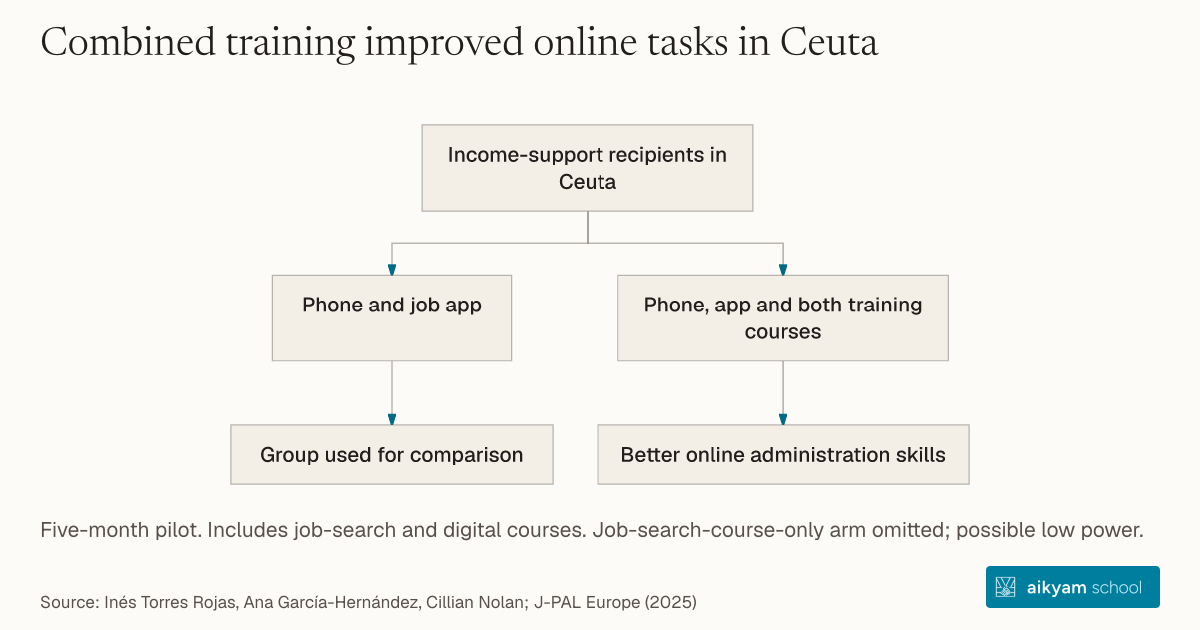
Income-support recipients in Ceuta
- Phone and job app
- Group used for comparison
- Phone, app and both training courses
- Better online administration skills
Five-month pilot. Includes job-search and digital courses. Job-search-course-only arm omitted; possible low power.
See source →Research question
Economically excluded welfare recipients struggle with digital administrative procedures and online job applications due to a lack of hardware access and foundational digital skills.
Participants
713 unemployed recipients of minimum income schemes in Ceuta, Spain (243 Treatment 1, 231 Treatment 2, 239 comparison).
Study Design
Randomised Controlled Trial (RCT) testing smartphone provision with a job search app alone, app plus 29 hours of job search strategy training (Treatment 1), and app plus 39 hours of digital literacy training (Treatment 2) over 5 months.
Results
Only Treatment 2 (which included 39 hours of digital literacy training) yielded a statistically significant positive impact on the completion of online administrative procedures, whereas none of the treatment arms improved job search skills, job search intensity, or life satisfaction.
Takeaway
Provide low-income job seekers with internet-connected smartphones pre-loaded with employment apps and pair them with 39 hours of structured digital literacy instruction to improve online e-government task execution.
Source and citation
See source →Read alongside the research
Plain-English glossary
Original explanations, informed by the references below. Examples are illustrations, not data from the studies above. The research text stays unchanged.
- Randomized controlled trial
A study that uses chance, like drawing lots, to decide who receives each option being compared. Researchers compare the groups’ outcomes to estimate the effect of those options.
ExampleA lottery assigns volunteers to a training programme or a comparison group. Researchers then compare their outcomes.
GET-IT glossary · Randomized study ↗Read more about randomized controlled trial →- Statistically significant
A label used when a result passes a chosen statistical threshold, often p < 0.05. It does not show how large or useful an effect is. A result that is not statistically significant does not prove there is no effect.
ExampleA study reports p = 0.03 against a 0.05 threshold. It passes that test, but the effect could still be too small to matter.
American Statistical Association · Statement on p-values ↗Read more about statistically significant →