In Simple Words
Think of a house with a leaky roof, broken wiring, and a jammed front door. Fixing only the front door lock (job search assistance) does not make the house livable. A one-stop shop model acts as a single general contractor who assesses all structural flaws at once and coordinates simultaneous repairs across housing, education, and employment support.
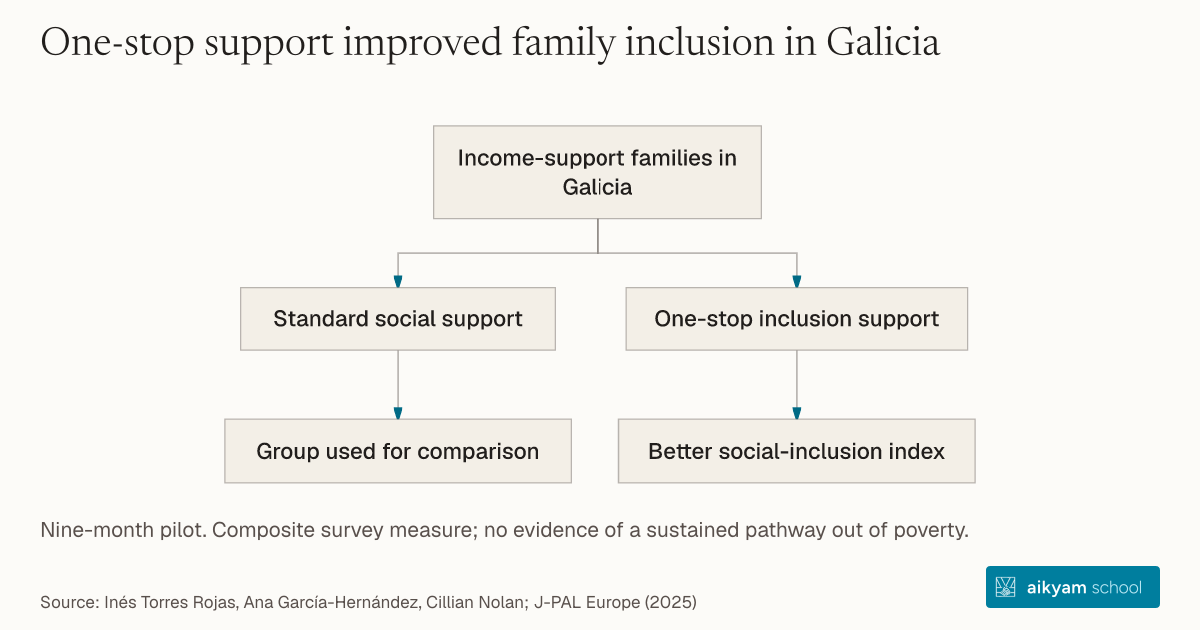
Income-support families in Galicia
- Standard social support
- Group used for comparison
- One-stop inclusion support
- Better social-inclusion index
Nine-month pilot. Composite survey measure; no evidence of a sustained pathway out of poverty.
See source →Research question
Vulnerable low-income households receiving minimum income assistance face complex, multidimensional obstacles—including housing instability, childcare deficits, and low educational attainment—that prevent standalone job search assistance from achieving sustained labor market entry.
Participants
2,359 families (1,060 treatment, 1,299 comparison) receiving minimum income schemes in Galicia, Spain.
Study Design
Randomised Controlled Trial (RCT) evaluating a 9-month integrated social protection model implemented by the Government of Galicia and local non-governmental organisations.
Results
The one-stop shop model improved overall synthetic indicators of social inclusion, housing conditions, parental skills, family satisfaction, and community integration, while reducing child material deprivation and increasing job search intensity, though it produced no statistically significant increase in short-term employment rates or earned income.
Takeaway
Integrate municipal social assistance and public employment services into unified single-window intake centers that conduct holistic family needs assessments and assign dedicated caseworkers to coordinate multi-sectoral support plans.
Source and citation
See source →Read alongside the research
Plain-English glossary
Original explanations, informed by the references below. Examples are illustrations, not data from the studies above. The research text stays unchanged.
- Randomized controlled trial
A study that uses chance, like drawing lots, to decide who receives each option being compared. Researchers compare the groups’ outcomes to estimate the effect of those options.
ExampleA lottery assigns volunteers to a training programme or a comparison group. Researchers then compare their outcomes.
GET-IT glossary · Randomized study ↗Read more about randomized controlled trial →- Statistically significant
A label used when a result passes a chosen statistical threshold, often p < 0.05. It does not show how large or useful an effect is. A result that is not statistically significant does not prove there is no effect.
ExampleA study reports p = 0.03 against a 0.05 threshold. It passes that test, but the effect could still be too small to matter.
American Statistical Association · Statement on p-values ↗Read more about statistically significant →