In Simple Words
Receiving welfare assistance through occasional individual appointments is like trying to learn a sport by taking a quick private lesson once a month. Establishing a dedicated physical clubhouse equipped with computers, ongoing group workshops, and a shared digital group chat creates a community center where participants encourage each other, share job leads, and practice administrative tasks together.
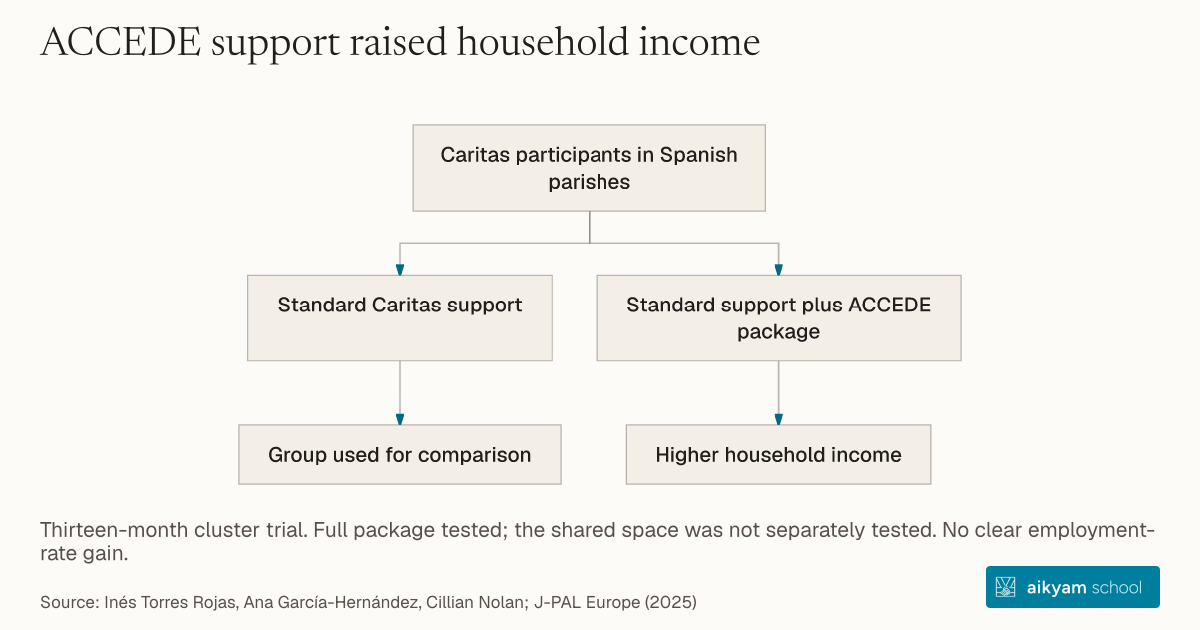
Caritas participants in Spanish parishes
- Standard Caritas support
- Group used for comparison
- Standard support plus ACCEDE package
- Higher household income
Thirteen-month cluster trial. Full package tested; the shared space was not separately tested. No clear employment-rate gain.
See source →Research question
Standard social welfare administration relies on isolated individual casework appointments, which fail to build peer support networks or provide physical digital access necessary for vulnerable households to navigate social rights and job opportunities.
Participants
2,625 social protection recipients across 96 parish locations in 18 Spanish municipalities (420 treatment, 1,205 comparison).
Study Design
Cluster Randomised Controlled Trial (RCT) evaluating a 13-month intensive support model by Cáritas featuring a physical hub space ("ACCEDE"), digital access points, WhatsApp group communication, and workshops on administrative rights and active job search.
Results
The ACCEDE intervention produced a large, positive impact on household income, boosted job applications, increased participation in recruitment interviews and vocational training, and enhanced internet access, social rights navigation, and community group participation.
Takeaway
Establish open-access physical hub spaces equipped with internet-connected computers and moderated peer messaging groups in local welfare offices to foster mutual assistance and active job search techniques.
Source and citation
See source →Read alongside the research
Plain-English glossary
Original explanations, informed by the references below. Examples are illustrations, not data from the studies above. The research text stays unchanged.
- Randomized controlled trial
A study that uses chance, like drawing lots, to decide who receives each option being compared. Researchers compare the groups’ outcomes to estimate the effect of those options.
ExampleA lottery assigns volunteers to a training programme or a comparison group. Researchers then compare their outcomes.
GET-IT glossary · Randomized study ↗Read more about randomized controlled trial →