In Simple Words
Think of a jobseeker living in a suburb where public transit does not reach commercial industrial parks. To get a job, having a car driver's license is a mandatory prerequisite, but taking driving lessons costs nearly $2,000. Receiving a monthly cash transfer allows the jobseeker to pay for driving lessons over time, acquiring the key credential required to reach distant employment sites.
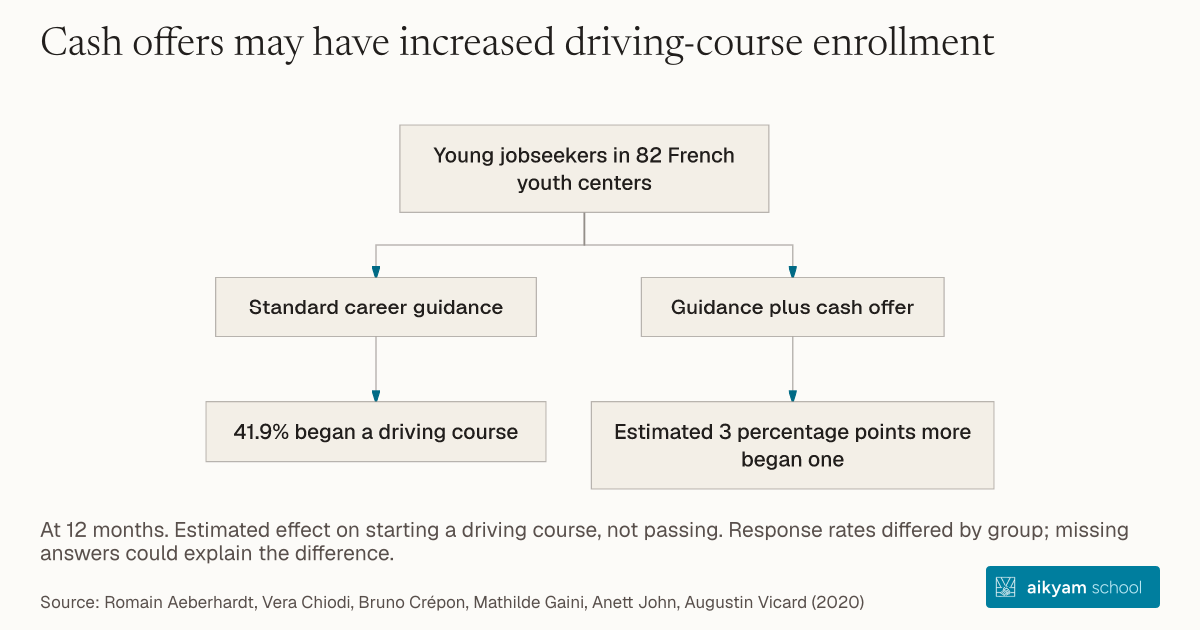
Young jobseekers in 82 French youth centers
- Standard career guidance
- 41.9% began a driving course
- Guidance plus cash offer
- Estimated 3 percentage points more began one
At 12 months. Estimated effect on starting a driving course, not passing. Response rates differed by group; missing answers could explain the difference.
See source →Research question
Geographic isolation and high credentialing costs create severe mobility bottlenecks for low-income jobseekers living in underprivileged suburbs. When general vocational training options are recommended by counselors, financial constraints prevent youth from acquiring costly, indivisible mobility assets like a driver's license without direct financial assistance.
Participants
N = 3,413 survey respondents (aged 18–22) across 82 Job Youth Centers in France.
Study Design
Randomized controlled trial (RCT) tracking specific human capital investment components (apprenticeships, internships, certified training courses, driver's licenses) at 12 and 24 months.
Results
Out of all measured human capital investment components, driver's license course enrollment was the only specific outcome significantly increased by cash transfers, rising by 3.0 percentage points (p < 0.05) from a control mean of 41.9% at 12 months, with automobile usage rising to 55.4% by 24 months (p < 0.05).
Takeaway
Incorporate dedicated mobility allowances or targeted driving instruction vouchers into youth employment programs to overcome spatial mismatch barriers.
Source and citation
See source →Read alongside the research
Plain-English glossary
Original explanations, informed by the references below. Examples are illustrations, not data from the studies above. The research text stays unchanged.
- Percentage points
The difference between two percentages.
ExampleA rise from 40% to 50% is 10 percentage points. Relative to the starting value, that is a 25% increase.
Office for National Statistics · Percentages ↗Read more about percentage points →- Randomized controlled trial
A study that uses chance, like drawing lots, to decide who receives each option being compared. Researchers compare the groups’ outcomes to estimate the effect of those options.
ExampleA lottery assigns volunteers to a training programme or a comparison group. Researchers then compare their outcomes.
GET-IT glossary · Randomized study ↗Read more about randomized controlled trial →