In Simple Words
Imagine a baker preparing for a festival. Before knowing how many visitors will attend, the baker buys expensive high-yield cake mixes that require sunny weather to bake properly. Preparing the dough in the morning (the planting stage) takes the exact same number of helpers whether it rains or shines. However, if the weather turns out great and a huge crowd arrives, the baker needs to hire a large team of evening workers to decorate and pack all the extra cakes (the harvest stage). Index insurance changes the baker's initial choice of cake mix, but only causes labor hiring to spike during the final packing stage when weather is good.
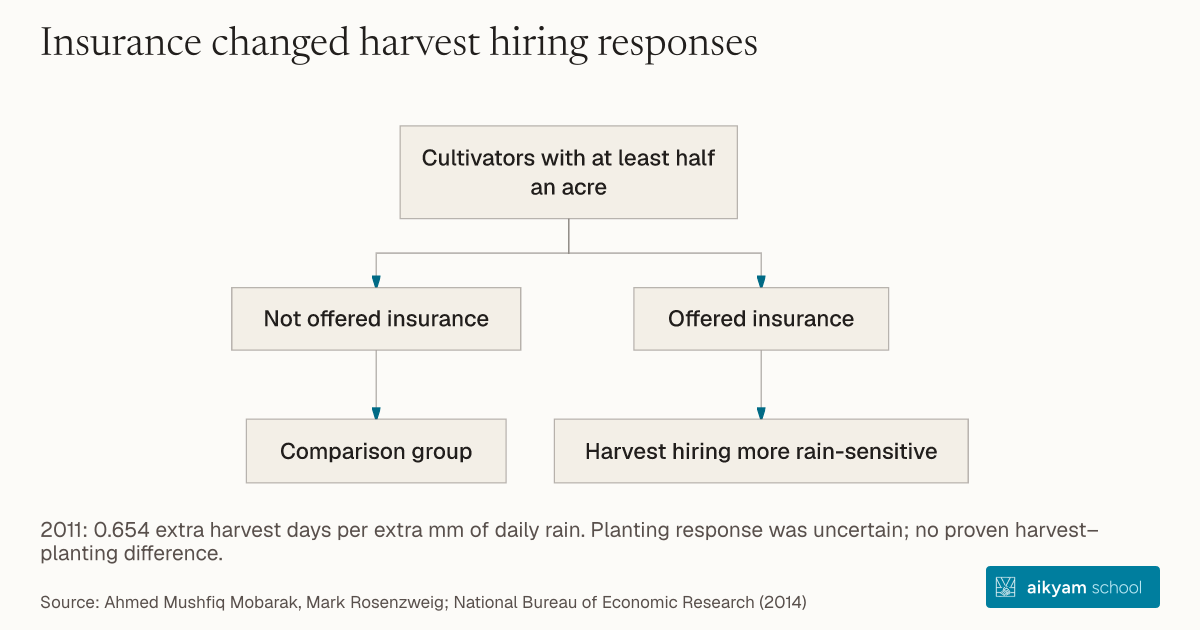
Cultivators with at least half an acre
- Not offered insurance
- Comparison group
- Offered insurance
- Harvest hiring more rain-sensitive
2011: 0.654 extra harvest days per extra mm of daily rain. Planting response was uncertain; no proven harvest–planting difference.
See source →Research question
Agricultural production occurs in distinct stages, with ex-ante planting decisions made before weather realizations and ex-post harvest decisions made after weather outcomes are known. While crop insurance increases the rainfall sensitivity of ex-post harvest labor demand by encouraging ex-ante investments in weather-sensitive inputs, it has zero effect on ex-ante planting-stage labor demand.
Participants
1,468 cultivating households owning >0.5 acres across 42 treatment villages in India.
Study Design
Village fixed-effects regression comparing ex-post harvest labor days against ex-ante planting labor days across insured and uninsured cultivators.
Results
Insurance significantly increases the rainfall elasticity of harvest labor demand ($\beta = 0.654, t = 2.39$), but has no statistically significant effect on planting-stage labor demand ($\beta = 0.459, t = 1.41$ or $\beta = 0.191, t = 0.48$ in placebo specifications).
Takeaway
Distinguish between ex-ante planting labor and ex-post harvest labor when evaluating labor market impacts of agricultural risk management policies.
Source and citation
See source →Read alongside the research
Plain-English glossary
Original explanations, informed by the references below. Examples are illustrations, not data from the studies above. The research text stays unchanged.
- Statistically significant
A label used when a result passes a chosen statistical threshold, often p < 0.05. It does not show how large or useful an effect is. A result that is not statistically significant does not prove there is no effect.
ExampleA study reports p = 0.03 against a 0.05 threshold. It passes that test, but the effect could still be too small to matter.
American Statistical Association · Statement on p-values ↗Read more about statistically significant →