In Simple Words
Direct wage deposit works like giving a worker their own private, lockable piggy bank rather than putting their paycheck into a family bowl on the kitchen table. When money goes straight into an individual's hands, they control how it gets spent, which makes working for money much more rewarding and worthwhile.
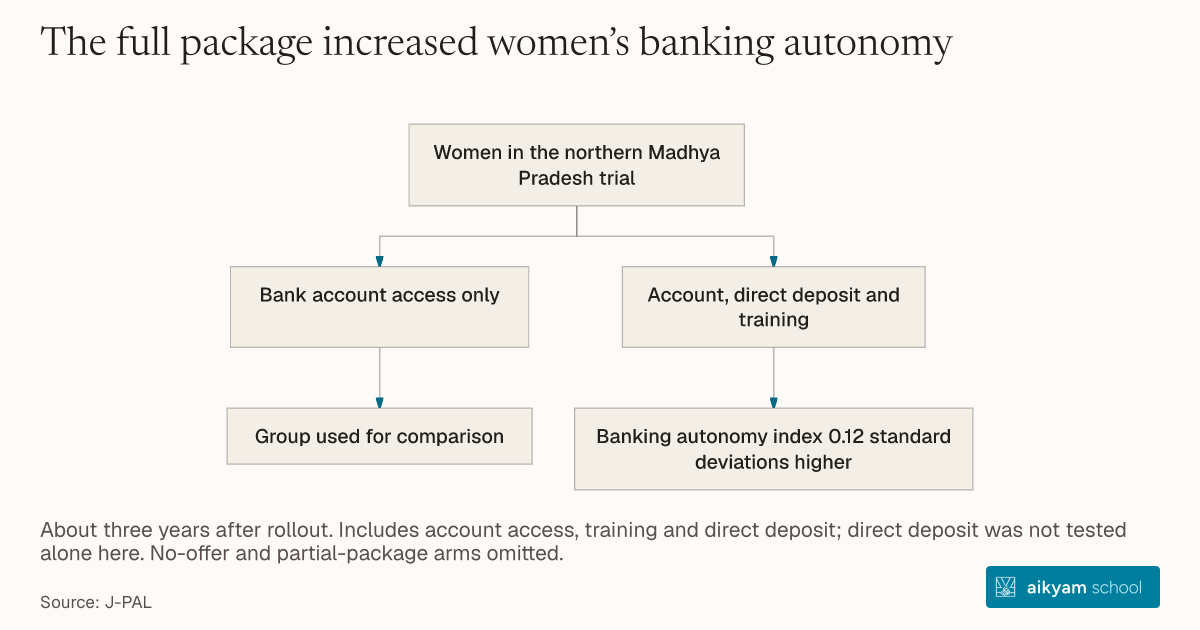
Women in the northern Madhya Pradesh trial
- Bank account access only
- Group used for comparison
- Account, direct deposit and training
- Banking autonomy index 0.12 standard deviations higher
About three years after rollout. Includes account access, training and direct deposit; direct deposit was not tested alone here. No-offer and partial-package arms omitted.
See source →Research question
When public work wages are deposited into household accounts controlled by male relatives, women lack direct financial control over their earnings, discouraging them from entering the labor force.
Participants
N = 5,851 women in 197 gram panchayats (village clusters) across Gwalior, Morena, Shivpuri, and Sheopur districts in Madhya Pradesh, India.
Study Design
Randomized Controlled Trial (RCT) with baseline census (2013–2014), short-run survey (2015), and long-run survey (2017) comparing a control group against four distinct treatment arms.
Results
Three years after implementation, average total wage deposits reached US$66 at contemporary exchange rates (equivalent to annual average wage earnings), and assignment to full treatment yielded a 0.12 standard deviation increase in the female banking autonomy index.
Takeaway
Transition public employment and work guarantee payments from joint household accounts to individual, gender-targeted bank accounts linked to direct deposit infrastructure.
Source and citation
See source →Read alongside the research
Plain-English glossary
Original explanations, informed by the references below. Examples are illustrations, not data from the studies above. The research text stays unchanged.
- Baseline
The starting measurements in a study. Researchers use these to compare what participants were like at the start with what happens later.
ExampleBefore a training programme starts, researchers measure workers’ earnings. That first measurement is the baseline.
GET-IT glossary · Baseline characteristics ↗Read more about baseline →- Randomized controlled trial
A study that uses chance, like drawing lots, to decide who receives each option being compared. Researchers compare the groups’ outcomes to estimate the effect of those options.
ExampleA lottery assigns volunteers to a training programme or a comparison group. Researchers then compare their outcomes.
GET-IT glossary · Randomized study ↗Read more about randomized controlled trial →