Try, learn and adjust
Check routine extension meeting delivery
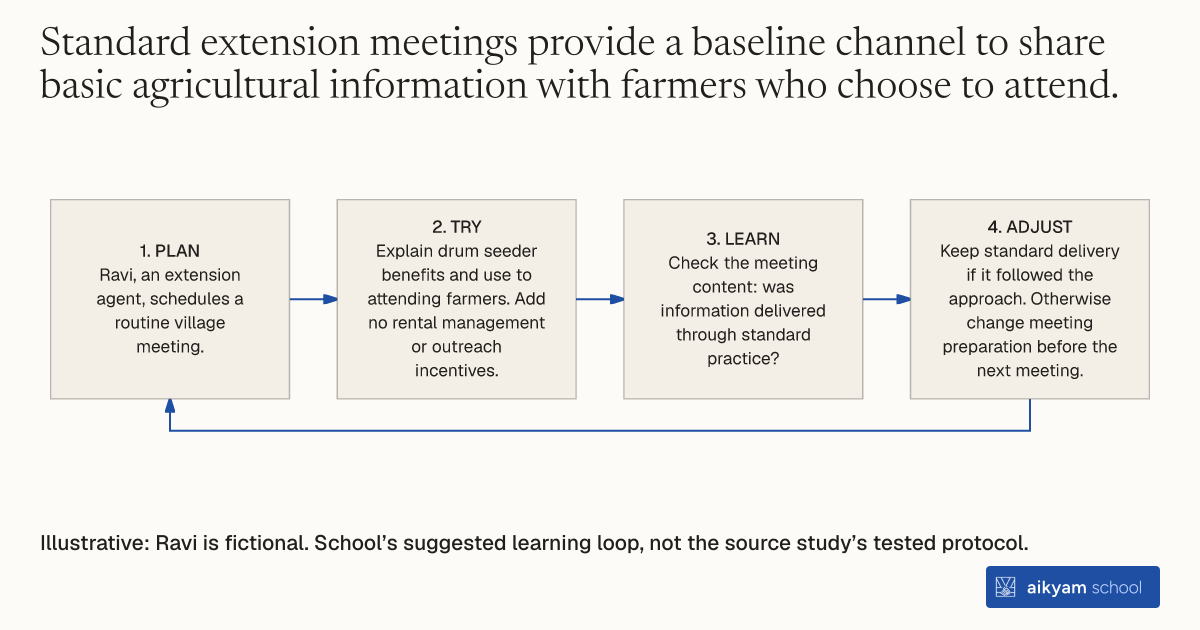
- Plan: Ravi, an extension agent, schedules a routine village meeting.
- Try: Explain drum seeder benefits and use to attending farmers. Add no rental management or outreach incentives.
- Learn: Check the meeting content: was information delivered through standard practice?
- Adjust: Keep standard delivery if it followed the approach. Otherwise change meeting preparation before the next meeting.
Illustrative: Ravi is fictional. School’s suggested learning loop, not the source study’s tested protocol.
See source →School’s suggested, untested learning loop. Observe meeting content and adherence to standard practice. Study results are forthcoming.
How
When to use
Agricultural extension agents often inform farmers about new technologies during routine extension meetings. However, attending farmers may not receive active follow-up support or equipment access. This standard information delivery approach serves as a baseline comparison when introducing new agricultural tools to smallholders.
Deliver technology information through standard extension meetings without offering equipment rental management or targeted incentives.
- The government extension agent schedules routine extension meetings in designated rural villages.
- The extension agent informs attending farmers about priority agricultural machinery such as drum seeders during the meeting.
- The extension agent provides general information about machine benefits and usage to attendees.
- The extension agent maintains standard practice without providing local equipment rental management or incentive-based outreach.
Why it works
It maintains standard government extension practices without adding local management or rental infrastructure costs.
Example
Government extensionists in Telangana, India continued their standard practice of informing attending farmers about drum seeders across 156 comparison villages.
About the study
Participants
156 comparison villages out of 400 total evaluation villages in Telangana, India, where farmers cultivate 2 hectares or less.
Study Design
Randomized controlled trial comparing status quo extension practice across 156 villages against 103 extensionist-managed rental villages and 102 leader-managed rental villages using multi-wave surveys and administrative data.
Results
Serves as the comparison group evaluating whether routine meeting information alone increases adoption beyond the estimated 8 percent regional drum seeding rate across central India; study results are ongoing and forthcoming.