In Simple Words
Imagine a fishing company that usually catches fish using traditional shore nets. If they buy a modern motorized boat with advanced sonar, they do not throw away their shore nets; instead, they keep using their shore nets at full capacity while sending the new boat out into deeper waters. Because the new boat catches fish from previously unreachable areas without interfering with the shore nets, the total catch grows larger instead of shifting from one net to another.
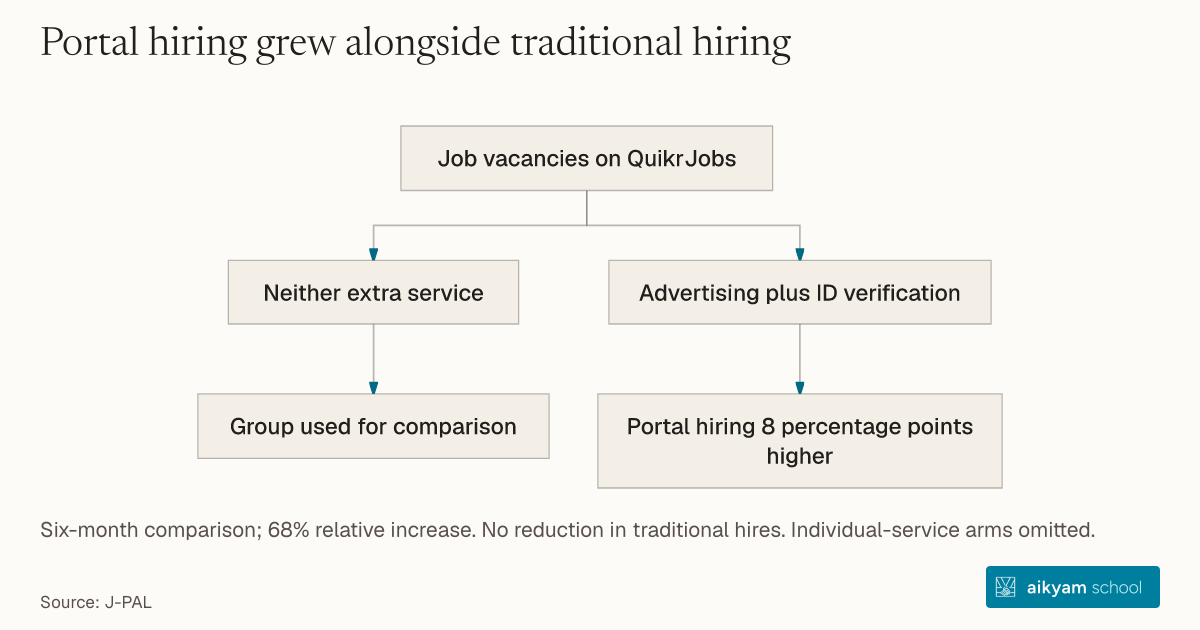
Job vacancies on QuikrJobs
- Neither extra service
- Group used for comparison
- Advertising plus ID verification
- Portal hiring 8 percentage points higher
Joint services raised portal hiring by 8 percentage points without reducing traditional-network hires, so more vacancies were filled overall. Six-month comparison; 68% relative increase. No reduction in traditional hires. Individual-service arms omitted.
See source →Research question
Employers frequently worry that adopting digital recruitment platforms will simply displace existing informal hiring channels rather than expanding total firm employment.
Participants
1,719 job vacancies across 1,576 urban firms in Bengaluru, India.
Study Design
Randomized Controlled Trial (RCT) with 6-month longitudinal tracking of overall firm hiring across portal and traditional recruitment channels.
Results
Firms in the combination advertising and verification group increased online portal hiring by 8 percentage points (68 percent increase) while maintaining baseline recruitment volume through traditional informal networks, resulting in net total vacancy expansion.
Takeaway
Integrate digital recruitment portals as additive sourcing streams alongside existing employee referral programs rather than replacing informal recruitment channels.
Source and citation
See source →Read alongside the research
Plain-English glossary
Original explanations, informed by the references below. Examples are illustrations, not data from the studies above. The research text stays unchanged.
- Baseline
The starting measurements in a study. Researchers use these to compare what participants were like at the start with what happens later.
ExampleBefore a training programme starts, researchers measure workers’ earnings. That first measurement is the baseline.
GET-IT glossary · Baseline characteristics ↗Read more about baseline →- Percentage points
The difference between two percentages.
ExampleA rise from 40% to 50% is 10 percentage points. Relative to the starting value, that is a 25% increase.
Office for National Statistics · Percentages ↗Read more about percentage points →- Randomized controlled trial
A study that uses chance, like drawing lots, to decide who receives each option being compared. Researchers compare the groups’ outcomes to estimate the effect of those options.
ExampleA lottery assigns volunteers to a training programme or a comparison group. Researchers then compare their outcomes.
GET-IT glossary · Randomized study ↗Read more about randomized controlled trial →