In Simple Words
Think of a person who has already lived in a big city and learned how to navigate local networking events versus a first-time visitor. When both are given a ticket to a high-profile conference, the experienced city dweller immediately knows how to swap contact details and turn conversations into job offers, whereas the newcomer misses those networking cues. Prior familiarity with short-term contract environments acts like a playbook for turning brief job exposure into long-term salary growth.
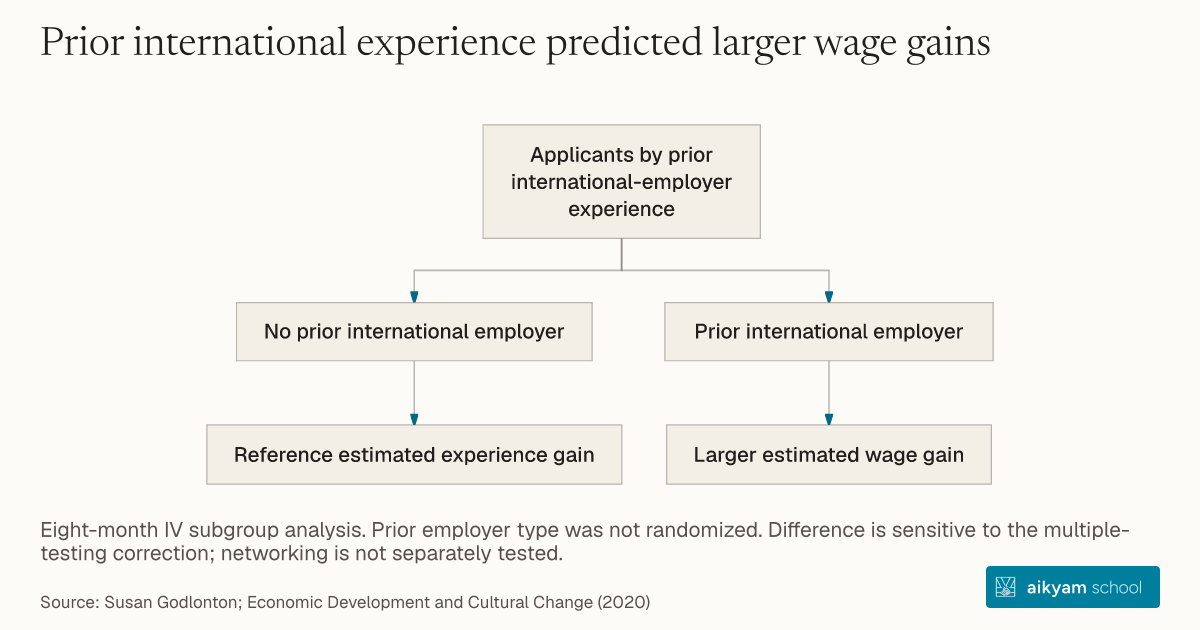
Applicants by prior international-employer experience
- No prior international employer
- Reference estimated experience gain
- Prior international employer
- Larger estimated wage gain
Eight-month IV subgroup analysis. Prior employer type was not randomized. Difference is sensitive to the multiple-testing correction; networking is not separately tested.
See source →Research question
The economic returns to short-term work opportunities vary widely across workers with different employment backgrounds. Workers with prior exposure to short-term contract sectors, such as international organizations, derive magnified wage returns from new work experience because they have already learned how to strategically leverage workplace social connections.
Participants
N = 227 urban male youth job seekers in Lilongwe, Malawi.
Study Design
Instrumental Variable (IV) interaction model estimating treatment effect heterogeneity across baseline international employer experience and research experience over an 8-month post-intervention period.
Results
The interaction between experimentally assigned work experience and baseline international employer experience on inverse hyperbolic sine daily wages is positive and statistically significant (interaction coefficient = 1.731, p < 0.05; Bonferroni-adjusted p = 0.041).
Takeaway
Pair short-term work placement opportunities with active networking coaching for workers lacking prior international or short-term contract exposure.
Source and citation
See source →Read alongside the research
Plain-English glossary
Original explanations, informed by the references below. Examples are illustrations, not data from the studies above. The research text stays unchanged.
- Baseline
The starting measurements in a study. Researchers use these to compare what participants were like at the start with what happens later.
ExampleBefore a training programme starts, researchers measure workers’ earnings. That first measurement is the baseline.
GET-IT glossary · Baseline characteristics ↗Read more about baseline →- Statistically significant
A label used when a result passes a chosen statistical threshold, often p < 0.05. It does not show how large or useful an effect is. A result that is not statistically significant does not prove there is no effect.
ExampleA study reports p = 0.03 against a 0.05 threshold. It passes that test, but the effect could still be too small to matter.
American Statistical Association · Statement on p-values ↗Read more about statistically significant →