In Simple Words
Imagine offering attendance bonuses at a community center in two different towns—one with abundant job openings and another with virtually no hiring. In the town without jobs, jobseekers have no alternative ways to earn income, so they attend every counselor meeting to secure the cash payment. In the thriving town, jobseekers can find short-term work, making the attendance bonus less critical to their monthly budget.
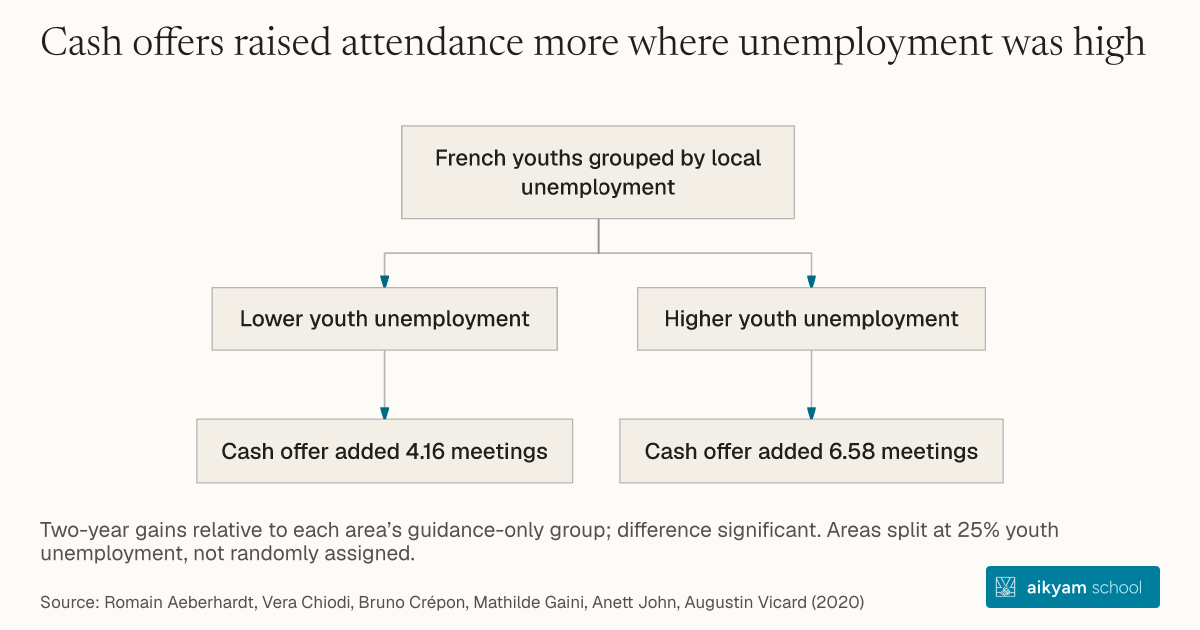
French youths grouped by local unemployment
- Lower youth unemployment
- Cash offer added 4.16 meetings
- Higher youth unemployment
- Cash offer added 6.58 meetings
Two-year gains relative to each area’s guidance-only group; difference significant. Areas split at 25% youth unemployment, not randomly assigned.
See source →Research question
Macroeconomic labor market conditions vary substantially across regions, altering the opportunity costs of program participation. In high-unemployment areas with severe job scarcity, jobseekers rely heavily on conditional cash transfers for basic income and increase meeting participation, whereas jobseekers in tight labor markets face lower reliance on transfer payments.
Participants
Sample of 5,492 youth across 82 French Job Youth Centers categorized by local youth unemployment rate (ranging from 12.7% to 58.4%, with a median of 25.0%).
Study Design
Randomized controlled trial (RCT) evaluating treatment effect interactions with local administrative youth unemployment rates.
Results
In areas with high youth unemployment (>25%), cash transfers increased counselor meetings by 6.58 (p < 0.01) versus 4.16 in low-unemployment areas (p < 0.01; equality test p < 0.01). Total personal monthly income increased significantly by €57.23 (p < 0.01) in high-unemployment regions, compared to a non-significant €19.05 increase in low-unemployment regions.
Takeaway
Scale financial assistance budgets for youth guidance programs based on local labor market tightness to support jobseekers in economically depressed regions.
Source and citation
See source →Read alongside the research
Plain-English glossary
Original explanations, informed by the references below. Examples are illustrations, not data from the studies above. The research text stays unchanged.
- Median
The middle number after arranging the values from smallest to largest. If there are two middle numbers, use their average.
ExampleFor the values 2, 4 and 12, the middle value is 4. The median is 4.
NIST · Measures of location ↗Read more about median →- Randomized controlled trial
A study that uses chance, like drawing lots, to decide who receives each option being compared. Researchers compare the groups’ outcomes to estimate the effect of those options.
ExampleA lottery assigns volunteers to a training programme or a comparison group. Researchers then compare their outcomes.
GET-IT glossary · Randomized study ↗Read more about randomized controlled trial →