In Simple Words
Giving participants a trackable ticket for a real item at a local shop acts as a real-world test of intention. By recording who actually walks into a clinic to claim physical health items, evaluators measure true behavioral demand without asking sensitive or easily faked survey questions.
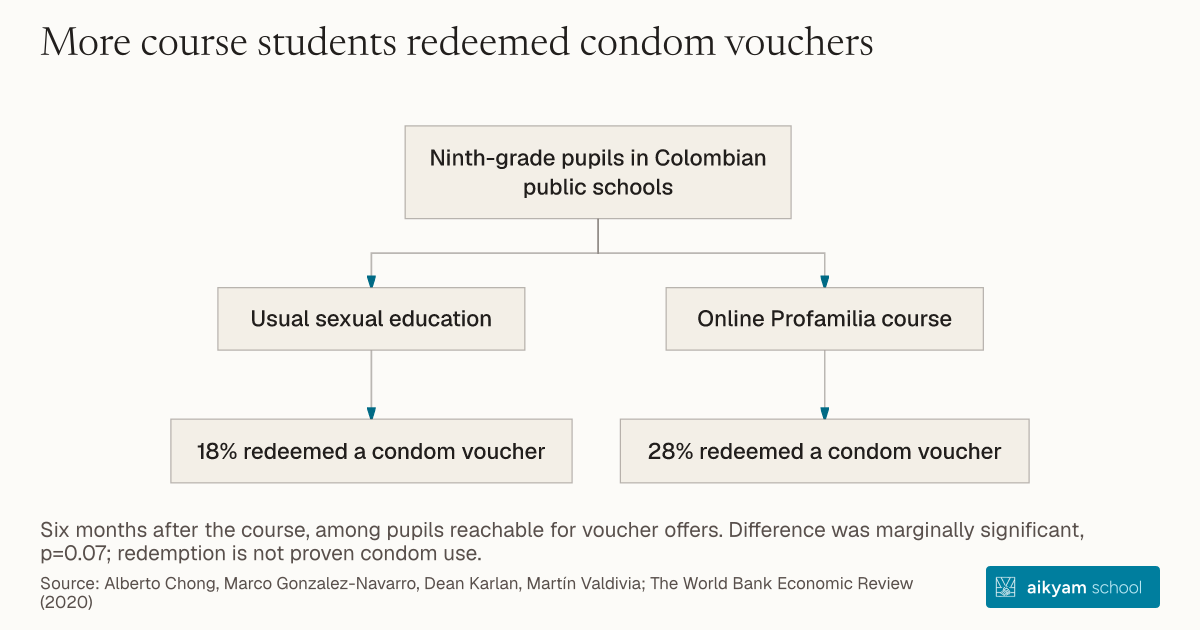
Ninth-grade pupils in Colombian public schools
- Usual sexual education
- 18% redeemed a condom voucher
- Online Profamilia course
- 28% redeemed a condom voucher
Six months after the course, among pupils reachable for voucher offers. Difference was marginally significant, p=0.07; redemption is not proven condom use.
See source →Research question
Evaluations of adolescent sexual health programs frequently rely on self-reported survey responses regarding sexual practices, which are highly susceptible to social desirability bias and recall inaccuracy.
Participants
N = 3,358 human high school students in Colombia who provided contact details for e-voucher distribution.
Study Design
Field experiment six months post-intervention delivering e-vouchers (via email/SMS) for 6 free condoms (US $5 market value) redeemable at local health clinics, matched via unique voucher identification numbers.
Results
Treatment group students demonstrated a 28% redemption rate compared to 18% in the control group, representing a 55% relative increase in condom demand (p = 0.07).
Takeaway
Distribute coded, redeemable vouchers for physical health commodities to objectively verify participant behavioral change in sensitive field evaluations.