Research procedure
Measure risk choices with real stakes
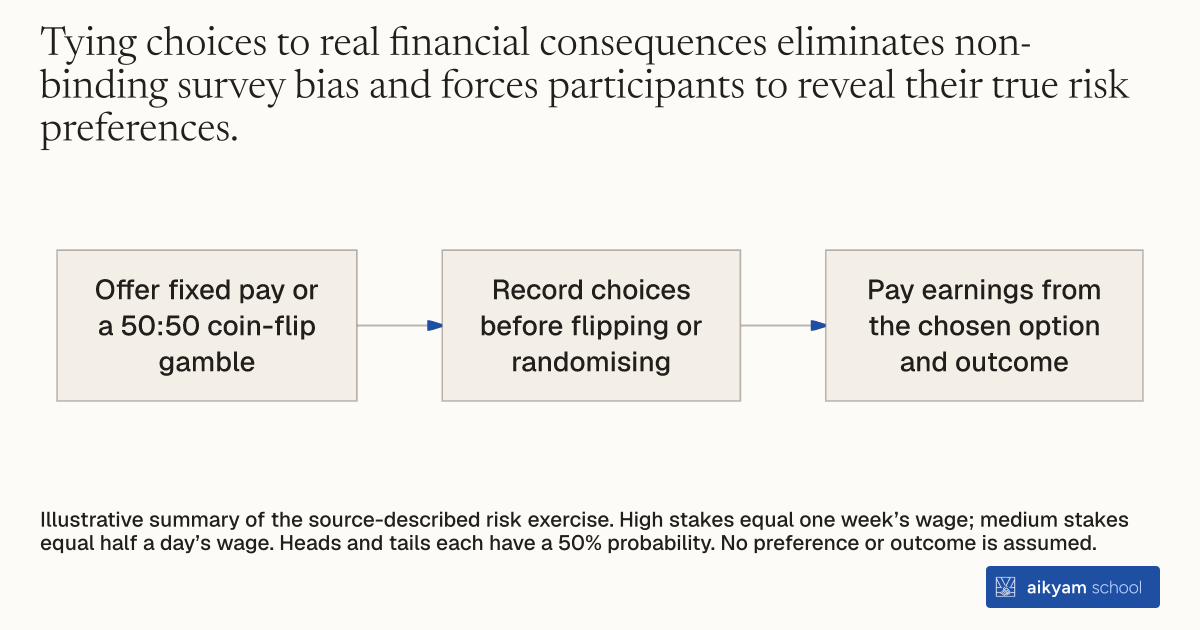
- Offer fixed pay or a 50:50 coin-flip gamble
- Record choices before flipping or randomising
- Pay earnings from the chosen option and outcome
Illustrative summary of the source-described risk exercise. High stakes equal one week’s wage; medium stakes equal half a day’s wage. Heads and tails each have a 50% probability. No preference or outcome is assumed.
See source →How
When to use
Organizations designing variable performance pay contracts need to evaluate whether employee opt-in decisions are driven by risk tolerance rather than productivity. Self-reported risk surveys often suffer from non-binding hypothetical bias and fail to capture real stakes decision-making. This method measures individual risk aversion using real financial payoffs tied to probabilistic outcomes during baseline worker evaluations.
Measure individual worker risk tolerance by offering participants choices across incentivized coin-flip gambles with real monetary payoffs.
- Present participants with choices between guaranteed fixed monetary payoffs and probabilistic coin-flip gambles during survey sessions.
- Structure high-stakes choices offering payout amounts equal to one week's wage and medium-stakes choices equal to half a day's wage.
- Explain the winning probability of 50 percent for heads and 50 percent for tails clearly to participants prior to recording decisions.
- Flip a physical coin or execute a computer randomizer immediately after choices are recorded to determine actual earnings.
- Pay out the resulting cash earnings directly to participants based on their chosen gamble and coin flip outcome.
Why it works
Standardized monetary stakes allow employers to isolate risk aversion from ability when assessing employee contract sorting.
Example
Researchers administered incentivized coin-flip games to private school teachers across Pakistan during baseline surveys in October 2017. Teachers chose between fixed cash amounts and coin flips with payouts equal to half a day's wage or a full week's wage. Teachers classified as more risk-loving in the coin-flip game were significantly more likely to select performance pay contracts over flat raise contracts.
About the study
Participants
1,284 private school teachers across Pakistan participating in baseline survey choice exercises; sample teachers averaged 35 years of age and 81 percent were female.
Study Design
Incentivized survey-based risk elicitation game with real monetary payoffs (half-day and full-week wage stakes) integrated into a baseline survey for a randomized controlled trial.
Results
Risk tolerance measured in the coin-flip game was a statistically significant positive predictor of selecting performance pay contracts, but controlling for risk preferences left the positive sorting coefficient between teacher value-added and performance pay choice unchanged at 0.047 standard deviations.