In Simple Words
Imagine a gym hiring private personal trainers and paying them a cash bonus for every person who signs up and attends a single workout class. The trainers focus on recruiting people who are already moderately active, while most invited members skip the classes because they already have workouts scheduled, and those who do attend return to their original fitness level once the promotion ends.
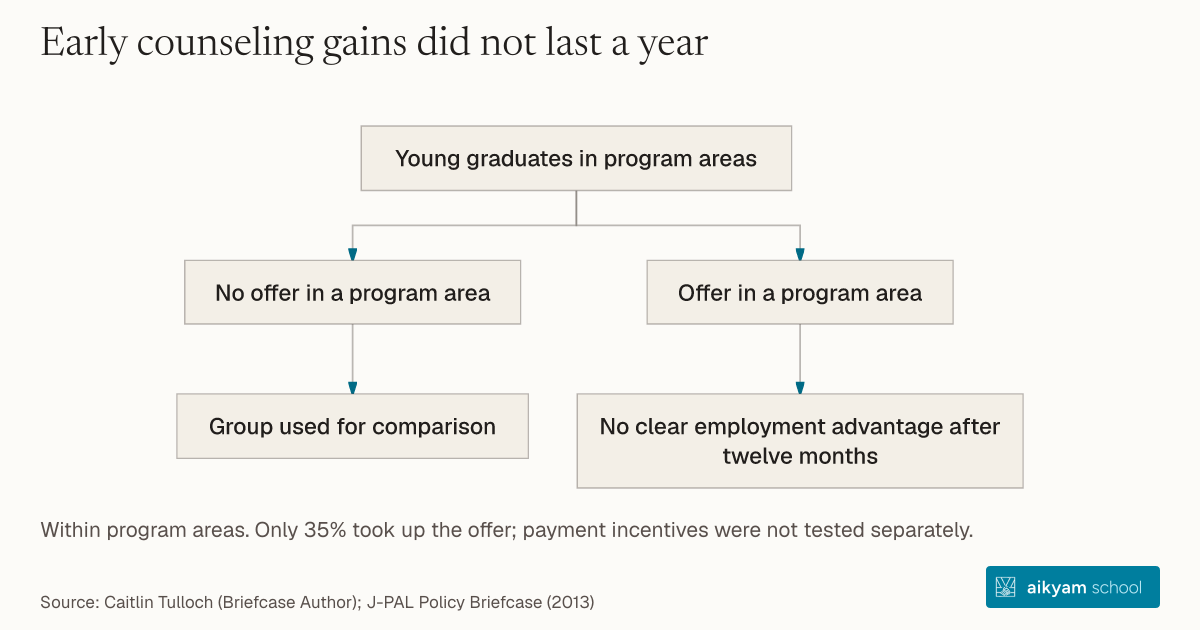
Young graduates in program areas
- No offer in a program area
- Group used for comparison
- Offer in a program area
- No clear employment advantage after twelve months
The original card reports that the early employment advantage disappeared after twelve months. This does not identify payment incentives as the cause. Within program areas. Only 35% took up the offer; payment incentives were not tested separately.
See source →Research question
Governments subcontract job placement services to private firms using financial incentives to improve efficiency over public employment agencies, but low program take-up and a reliance on short-term contractual placements limit long-term employment growth. Low participant enrollment combined with market displacement can fully offset the intended individual benefits of private career counseling.
Participants
Subgroup of nearly 30,000 young, college-educated French job seekers assigned to private agency counseling across 235 communities.
Study Design
Randomized evaluation of government subcontracting to private counseling agencies offering outcome targets (enrolling participants, finding 6+ month contracts, and maintaining 6-month employment retention) with payments up to €2,100 per person.
Results
Only 35 percent of job seekers offered intensive counseling enrolled in the program, short-term employment gains at eight months were driven entirely by fixed-term contracts rather than permanent contracts, and all employment advantages disappeared completely after twelve months.
Takeaway
Structure public employment subcontracting agreements to require minimum enrollment benchmarks and tie financial rewards to long-term permanent job contracts rather than temporary positions.