In Simple Words
Personal initiative training acts like installing an autonomous self-starting motor inside an entrepreneur rather than giving them a complex instruction manual. Instead of teaching rigid administrative tasks, the training conditions business owners to actively seek new opportunities, anticipate market shifts, and persist independently when facing operational obstacles.
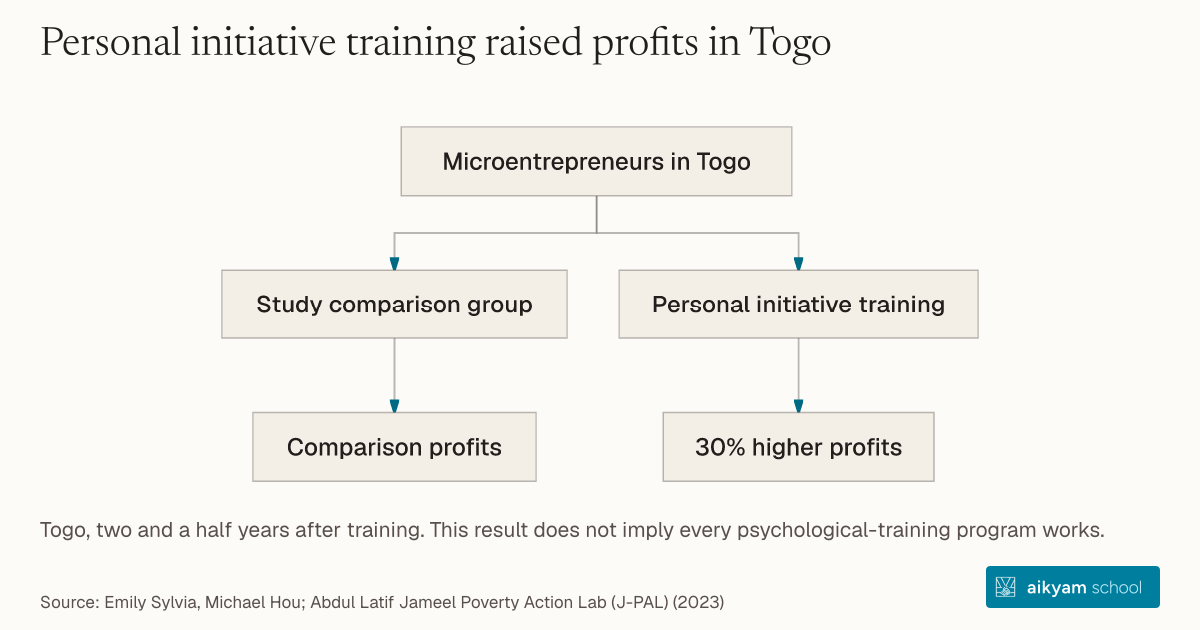
Microentrepreneurs in Togo
- Study comparison group
- Comparison profits
- Personal initiative training
- 30% higher profits
Two and a half years after the Togo program. Personal initiative training increased profits; other psychological-training evaluations had mixed or fading results.
See source →Research question
Traditional classroom-based business skills trainings focus heavily on basic accounting, marketing, and inventory practices, yet microentrepreneurs frequently fail to sustain these practices over time or translate them into higher long-term profits. Traditional curricula often overwhelm business owners with technical information rather than addressing underlying entrepreneurial mindsets.
Participants
Human microentrepreneurs in Togo, West Africa (evaluated as part of a multi-country synthesis covering 28 randomized evaluations across developing nations).
Study Design
Randomized Controlled Trial (RCT) with longitudinal follow-up 2.5 years post-intervention.
Results
Microentrepreneurs in Togo who received personal initiative training increased adoption of business practices by 5.4 percentage points and boosted firm profits by 30% relative to the comparison group 2.5 years after training.
Takeaway
Structure entrepreneurship workshops around active mindset exercises—such as identifying untapped local market gaps and building proactive problem-solving habits—rather than focusing exclusively on ledger maintenance.
Source and citation
See source →Read alongside the research
Plain-English glossary
Original explanations, informed by the references below. Examples are illustrations, not data from the studies above. The research text stays unchanged.
- Longitudinal study
A study that checks the same group of people at different times. This lets researchers examine how things change over time.
ExampleResearchers ask the same workers about their wellbeing at the start, after three months and after six months.
NICE · Longitudinal study ↗Read more about longitudinal study →- Follow-up
Collecting more information about participants later in a study to see what has happened to them. The term can also mean the length of time researchers keep track of them.
ExampleResearchers interview the same workers three months after a programme ends. That later interview is a follow-up.
GET-IT glossary · Follow-up ↗Read more about follow-up →- Percentage points
The difference between two percentages.
ExampleA rise from 40% to 50% is 10 percentage points. Relative to the starting value, that is a 25% increase.
Office for National Statistics · Percentages ↗Read more about percentage points →- Randomized controlled trial
A study that uses chance, like drawing lots, to decide who receives each option being compared. Researchers compare the groups’ outcomes to estimate the effect of those options.
ExampleA lottery assigns volunteers to a training programme or a comparison group. Researchers then compare their outcomes.
GET-IT glossary · Randomized study ↗Read more about randomized controlled trial →