In Simple Words
Instead of a business owner reading hundreds of unvetted job applications, a public agency acts as a security guard who pre-filters all incoming resumes against agreed-upon criteria and passes only 5 to 10 top candidate profiles directly to the boss's desk.
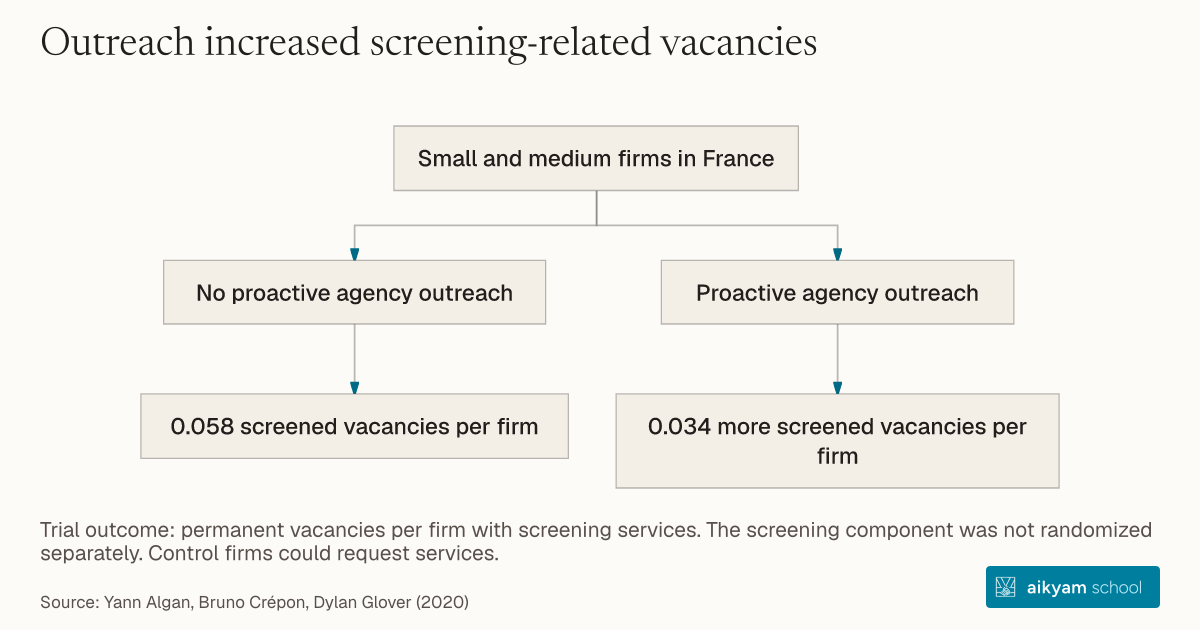
Small and medium firms in France
- No proactive agency outreach
- 0.058 screened vacancies per firm
- Proactive agency outreach
- 0.034 more screened vacancies per firm
Trial outcome: permanent vacancies per firm with screening services. The screening component was not randomized separately. Control firms could request services.
See source →Research question
Employers in slack labor markets face significant screening costs due to overwhelming volumes of candidate resumes, which creates recruitment bottlenecks and delays job creation.
Participants
N = 7,438 small and medium-sized firms (5 to 250 employees) in France.
Study Design
Stratified randomized controlled trial (RCT) evaluating public agency screening interventions versus standard passive recruitment channels.
Results
Vacancies in treated firms experienced a 58% increase in pre-screening and filtering service usage (3.4 percentage points over 5.8% control mean, p < 0.01) and a 57% increase in private listings, leading to a 39% reduction in direct jobseeker application volume (2.67 fewer applications, p < 0.01) and 0.84 fewer firm-initiated candidate searches (p < 0.01).
Takeaway
Delegate resume screening to external public recruitment counselors who establish pre-selection criteria and limit final interview slates to a maximum of 10 pre-verified candidates.
Source and citation
See source →Read alongside the research
Plain-English glossary
Original explanations, informed by the references below. Examples are illustrations, not data from the studies above. The research text stays unchanged.
- Percentage points
The difference between two percentages.
ExampleA rise from 40% to 50% is 10 percentage points. Relative to the starting value, that is a 25% increase.
Office for National Statistics · Percentages ↗Read more about percentage points →- Randomized controlled trial
A study that uses chance, like drawing lots, to decide who receives each option being compared. Researchers compare the groups’ outcomes to estimate the effect of those options.
ExampleA lottery assigns volunteers to a training programme or a comparison group. Researchers then compare their outcomes.
GET-IT glossary · Randomized study ↗Read more about randomized controlled trial →