Try, learn and adjust
Use downtime logs to plan repairs
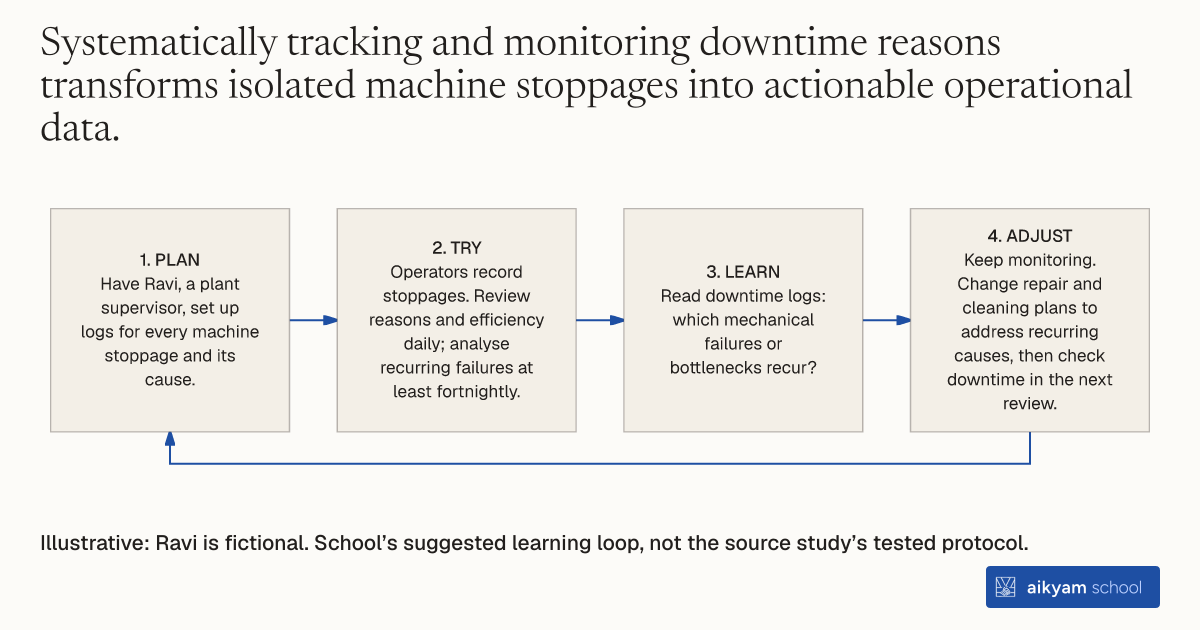
- Plan: Have Ravi, a plant supervisor, set up logs for every machine stoppage and its cause.
- Try: Operators record stoppages. Review reasons and efficiency daily; analyse recurring failures at least fortnightly.
- Learn: Read downtime logs: which mechanical failures or bottlenecks recur?
- Adjust: Keep monitoring. Change repair and cleaning plans to address recurring causes, then check downtime in the next review.
Illustrative: Ravi is fictional. School’s suggested learning loop, not the source study’s tested protocol.
See source →School’s suggested, untested loop: observe stoppage causes, machine uptime and completed action plans; lower downtime is not assumed.
How
When to use
Manufacturing plants often experience persistent machine breakdowns and output losses because equipment stoppage causes are not systematically logged or analyzed. This method establishes continuous downtime tracking, daily cause monitoring, and regular fortnightly review meetings to execute operational fixes. It enables plant supervisors and production engineers to reduce machine idle time and improve loom efficiency.
Implement a systematic machine downtime tracking and action planning system to log breakdowns, analyze root causes, and execute preventive fixes.
- Floor workers and machine operators record every machine stoppage and breakdown on standardized paper tracking logs on the shop floor.
- Plant supervisors monitor and tally machine downtime reasons daily across all production looms.
- Production teams hold daily efficiency meetings with supervisors and operators to review daily machine uptime and downtime figures.
- Plant managers and engineers analyze aggregated downtime data at least fortnightly to identify recurring mechanical failures and operational bottlenecks.
- Production management formulates and implements concrete action plans to repair malfunctioning equipment, clean factory spaces, and reduce future machine downtime.
Why it works
Conducting regular review meetings ensures maintenance problems are promptly diagnosed and resolved through structured action plans.
Example
In 2008, international consultants introduced machine downtime recording and fortnightly action planning across experimental textile plants in Mumbai, India. By 2011, downtime recording reached 90% of plants and fortnightly action planning rose from 5% at baseline to 65% in 2011 and 60% in 2017, with 80% of adopters retaining the action planning system long-term.
About the study
Participants
28 manufacturing plants across 17 family-owned cotton weaving firms near Mumbai, India, averaging 270 employees, \$8.5 million in assets, and \$7.5 million in annual sales.
Study Design
Randomized Controlled Trial (RCT) tracking 38 management practices across treatment and control plants from 2008 to 2017.
Results
Machine downtime recording increased from 60% of treatment plants in 2008 to 90% in 2011 and 2017, while fortnightly analysis and action planning increased from 5% in 2008 to 65% in 2011 and maintained a 60% adoption rate in 2017.