In Simple Words
Think of paying for express shipping on a package versus changing what is inside the box. The package arrives at the front door a few days earlier, but the contents of the box remain identical. Over a longer timeframe, having received the package early does not increase the total number of items delivered.
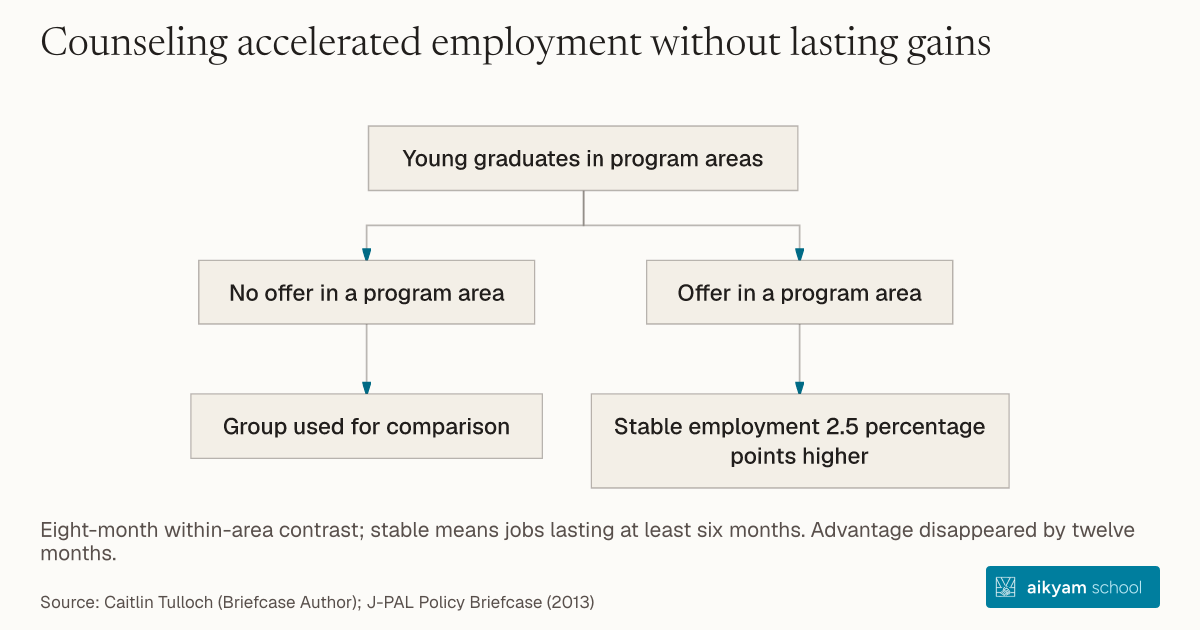
Young graduates in program areas
- No offer in a program area
- Group used for comparison
- Offer in a program area
- Stable employment 2.5 percentage points higher
At eight months the counseling offer increased long-term employment by 2.5 percentage points relative to unoffered peers in the same areas; the gain disappeared by twelve months. Eight-month within-area contrast; stable means jobs lasting at least six months. Advantage disappeared by twelve months.
See source →Research question
Job search counseling helps unemployed individuals navigate hiring processes and connect with employers faster, which accelerates job matching in the short run. However, unless counseling improves underlying skills or job quality, it merely reschedules when employment occurs rather than increasing total long-term employment rates.
Participants
Nearly 30,000 young, college-educated French job seekers in mid-twenties tracked across 235 communities over nearly two years.
Study Design
Clustered randomized evaluation measuring long-term employment rates at 8, 12, and 20 months following the offer of intensive career counseling.
Results
Treated job seekers had a statistically significant 2.5 percentage point employment advantage over untreated peers at 8 months, but by 12 and 20 months, employment rates between treated and comparison groups were identical.
Takeaway
Measure employment policy impacts over multi-year horizons to ensure interventions create sustainable labor market attachment rather than brief search acceleration.
Source and citation
See source →Read alongside the research
Plain-English glossary
Original explanations, informed by the references below. Examples are illustrations, not data from the studies above. The research text stays unchanged.
- Percentage points
The difference between two percentages.
ExampleA rise from 40% to 50% is 10 percentage points. Relative to the starting value, that is a 25% increase.
Office for National Statistics · Percentages ↗Read more about percentage points →- Statistically significant
A label used when a result passes a chosen statistical threshold, often p < 0.05. It does not show how large or useful an effect is. A result that is not statistically significant does not prove there is no effect.
ExampleA study reports p = 0.03 against a 0.05 threshold. It passes that test, but the effect could still be too small to matter.
American Statistical Association · Statement on p-values ↗Read more about statistically significant →