In Simple Words
Imagine two partners living together where legal rules state that everything must be split fifty-fifty if they break up. If one partner wins money held in a personal bank account, that partner gains the power to take extra time off work while remaining in the relationship, showing that personal control of money improves day-to-day bargaining inside the relationship rather than just affecting breakup decisions.
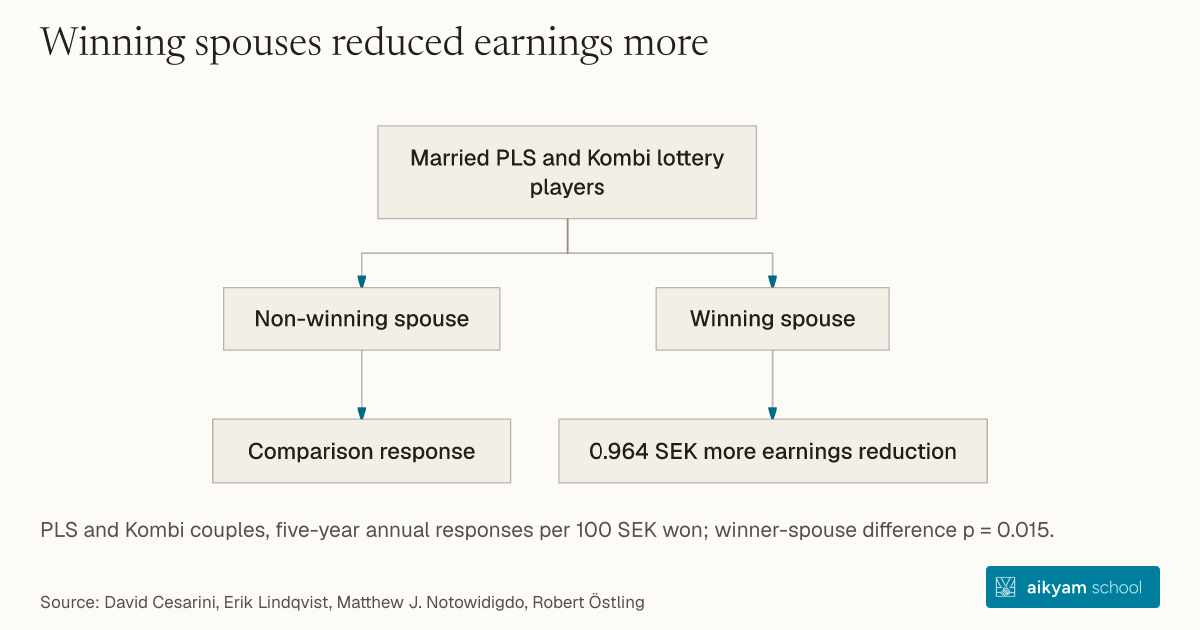
Married PLS and Kombi lottery players
- Non-winning spouse
- Comparison response
- Winning spouse
- 0.964 SEK more earnings reduction
Five-year annual pretax earnings responses per 100 SEK won. The winner-spouse difference was statistically significant; household bargaining remains an interpretation.
See source →Research question
Determining how unearned wealth alters bargaining power within married couples requires identifying whether threat points during disagreements depend on internal marital arrangements or external divorce outcomes. Empirical verification tests whether statutory equal-split divorce laws negate individual financial windfalls.
Participants
N = 140,398 married couples in the PLS and Kombi Swedish lottery samples.
Study Design
Comparative empirical analysis tracking 5-year pre-tax earnings adjustments between winning spouses and non-winning spouses under Swedish family law, which enforces equal asset division upon divorce.
Results
Winning spouses reduce pre-tax labor earnings by 0.964 SEK more per 100 SEK won than non-winning spouses (p = 0.015); because legal asset division upon divorce is equal regardless of winner identity, the disparity supports internal non-cooperative separate-spheres threat points rather than external divorce-threat bargaining models.
Takeaway
Design intra-household transfer programs that assign benefits directly to target individuals rather than relying on statutory household-level divorce division laws to equalize intra-household allocation.