In Simple Words
Think of a safety net that disappears the moment a worker steps onto a tightrope. If stepping onto the formal job tightrope risks losing guaranteed family safety-net payments, the worker will remain safely grounded in informal employment.
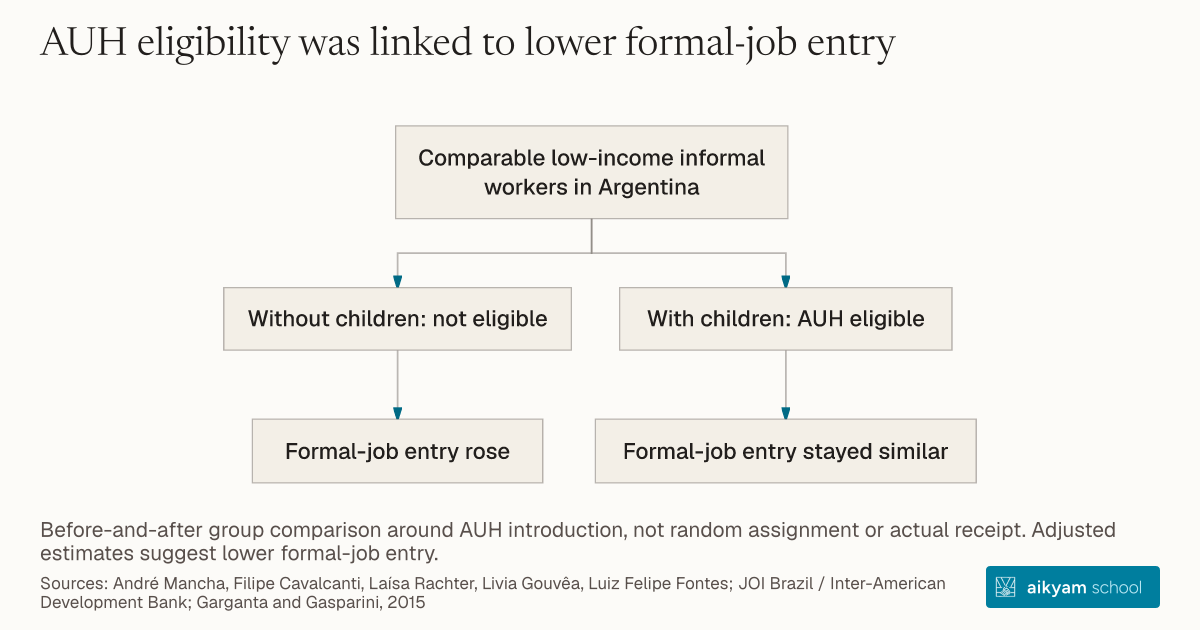
Comparable low-income informal workers in Argentina
- Without children: not eligible
- Formal-job entry rose
- With children: AUH eligible
- Formal-job entry stayed similar
Before-and-after group comparison around AUH introduction, not random assignment or actual receipt. Adjusted estimates suggest lower formal-job entry.
See source →Study conditions — Garganta and Gasparini, 2015 ↗Research question
Targeted cash assistance programs that restrict eligibility exclusively to informal or unemployed citizens inadvertently penalize beneficiaries who transition into formal jobs.
Participants
Informal workers with children in Argentina eligible for Universal Child Allowance (AUH) (Garganta and Gasparini, 2015).
Study Design
Quasi-experimental difference-in-differences impact evaluation.
Results
Monthly cash transfers restricted to non-formal workers created a statistically significant disincentive for program beneficiaries to accept formal employment contracts.
Takeaway
Design social protection transfers with gradual benefit roll-offs or universal coverage guarantees that persist regardless of formal employment status.
Source and citation
See source →Evidence in Labor Market Policies and Implications for Brazil: Informality
Copyright © 2025 Inter-American Development Bank.
Full source notice
Copyright © 2025 Inter-American Development Bank ("IDB"). This work is subject to a Creative Commons license CC BY 3.0 IGO (https://creativecommons.org/licenses/by/3.0/igo/legalcode). The terms and conditions indicated in the URL link must be met and the respective recognition must be granted to the IDB. Further to section 8 of the above license, any mediation relating to disputes arising under such license shall be conducted in accordance with the WIPO Mediation Rules. Any dispute related to the use of the works of the IDB that cannot be settled amicably shall be submitted to arbitration pursuant to the United Nations Commission on International Trade Law (UNCITRAL) rules. The use of the IDB's name for any purpose other than for attribution, and the use of IDB's logo shall be subject to a separate written license agreement between the IDB and the user and is not authorized as part of this license. Note that the URL link includes terms and conditions that are an integral part of this license.
Read alongside the research
Plain-English glossary
Original explanations, informed by the references below. Examples are illustrations, not data from the studies above. The research text stays unchanged.
- Statistically significant
A label used when a result passes a chosen statistical threshold, often p < 0.05. It does not show how large or useful an effect is. A result that is not statistically significant does not prove there is no effect.
ExampleA study reports p = 0.03 against a 0.05 threshold. It passes that test, but the effect could still be too small to matter.
American Statistical Association · Statement on p-values ↗Read more about statistically significant →