In Simple Words
Think of spending five days inside a new workplace as joining a temporary community center. Even if the actual tasks do not teach complex technical skills, interacting with coworkers and supervisors connects individuals to an active web of contacts who share unadvertised job opportunities. The short work assignment serves as a bridge that expands the worker's social network for future employment referrals.
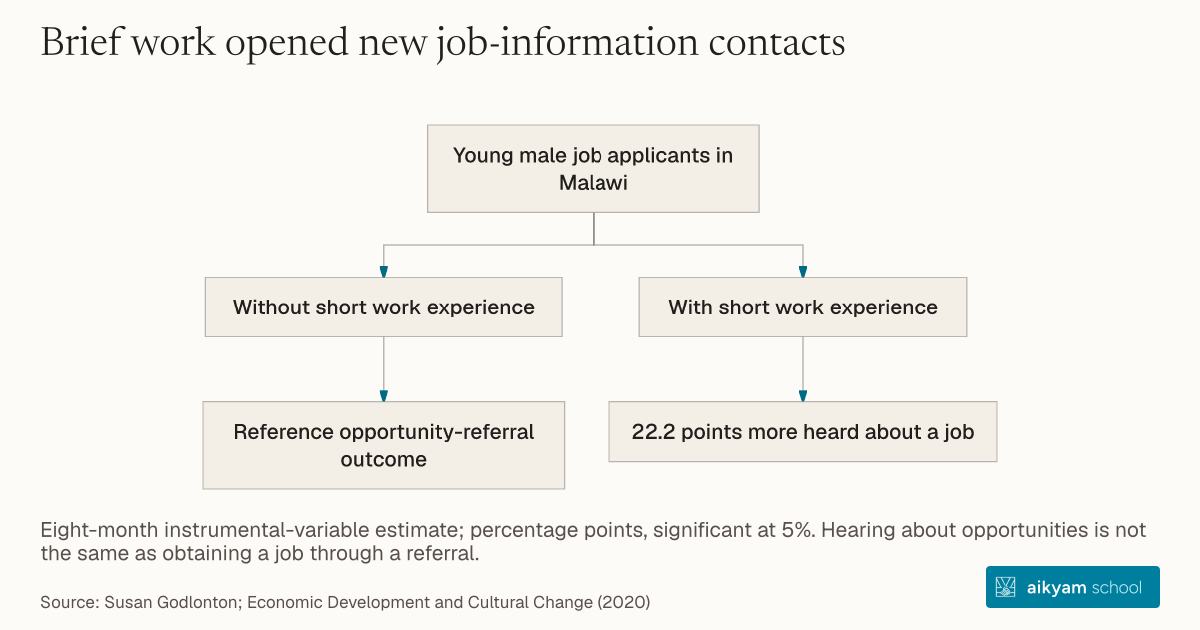
Young male job applicants in Malawi
- Without short work experience
- Reference opportunity-referral outcome
- With short work experience
- 22.2 points more heard about a job
Eight-month instrumental-variable estimate; percentage points, significant at 5%. Hearing about opportunities is not the same as obtaining a job through a referral.
See source →Research question
Short-term job placement programs often generate significant future wage increases without increasing formal skills or reference letter usage, creating uncertainty around the mechanism driving sustained earnings. Identifying whether social contact expansion drives these labor market gains clarifies how brief work opportunities transmit economic value.
Participants
N = 215 male job seekers completing follow-up social network modules in Lilongwe, Malawi.
Study Design
Instrumental Variable (IV) estimation comparing job referral rates, contact discovery, and a standardized social network index across post-intervention employment records.
Results
Experimentally induced short-term work experience increases the likelihood of hearing about a job opportunity through contacts met during the intervention by 22.2 percentage points (p < 0.05). It increases the standardized social network index by 0.306 standard deviations (p < 0.10).
Takeaway
Design active labor market programs to maximize direct social interaction among participants and supervisors rather than relying exclusively on isolated technical instruction.
Source and citation
See source →Read alongside the research
Plain-English glossary
Original explanations, informed by the references below. Examples are illustrations, not data from the studies above. The research text stays unchanged.
- Follow-up
Collecting more information about participants later in a study to see what has happened to them. The term can also mean the length of time researchers keep track of them.
ExampleResearchers interview the same workers three months after a programme ends. That later interview is a follow-up.
GET-IT glossary · Follow-up ↗Read more about follow-up →- Percentage points
The difference between two percentages.
ExampleA rise from 40% to 50% is 10 percentage points. Relative to the starting value, that is a 25% increase.
Office for National Statistics · Percentages ↗Read more about percentage points →