Try, learn and adjust
Check participation across therapy and training
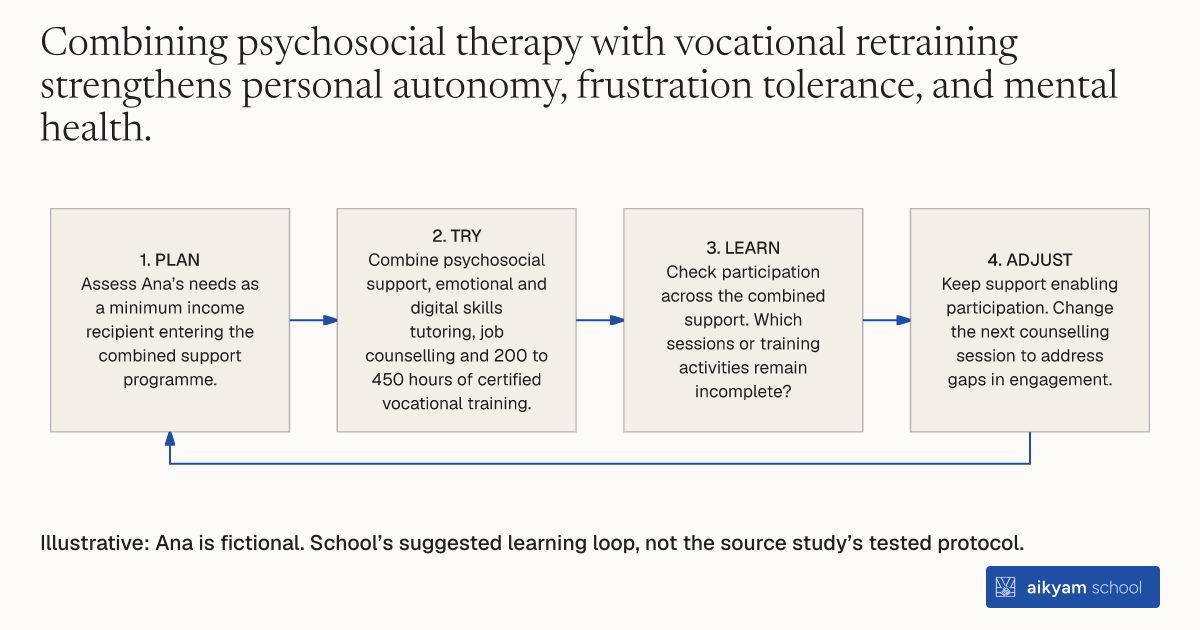
- Plan: Assess Ana’s needs as a minimum income recipient entering the combined support programme.
- Try: Combine psychosocial support, emotional and digital skills tutoring, job counselling and 200 to 450 hours of certified vocational training.
- Learn: Check participation across the combined support. Which sessions or training activities remain incomplete?
- Adjust: Keep support enabling participation. Change the next counselling session to address gaps in engagement.
Illustrative: Ana is fictional. School’s suggested learning loop, not the source study’s tested protocol.
See source →School’s suggested, untested loop: observe participation in the package. Project completion was 25%; the trial found no short-term employment effect.
How
When to use
Low-income welfare beneficiaries experiencing long-term unemployment often struggle with mental health challenges and lack technical skills. Standard vocational training programs without psychological support fail to address personal autonomy barriers that prevent job search success. This method combines certified vocational retraining with psychosocial therapy and career guidance for minimum income recipients.
Deliver certified vocational training combined with psychosocial therapy, emotional skills tutoring, and career counselling for welfare recipients.
- Social workers conduct intake assessments to enroll minimum income recipients into the dual support program.
- Therapists provide targeted psychosocial support sessions to address mental health risks and emotional distress.
- Tutors lead socio-emotional skills and digital literacy tutoring sessions to strengthen personal autonomy.
- Employment advisors deliver personalized job search assistance and career counselling.
- Instructors conduct certified professional training courses lasting between 200 and 450 hours in specialized vocational subjects.
Why it works
Restoring emotional well-being enables job seekers to utilize new technical qualifications and broaden their job search strategies.
Example
Cruz Roja Española delivered an intensive employment program for 1,364 minimum income beneficiaries across six Spanish provinces over seven months. Participants received psychosocial support, socio-emotional tutoring, job counseling, and 200 to 450 hours of certified vocational training. The program reduced participants' risk of mental health problems, increased frustration tolerance, improved knowledge of public resources, and expanded job search strategies.
About the study
Participants
1,364 beneficiaries of minimum income schemes (683 treatment group, 681 comparison group) across six Spanish provinces.
Study Design
Randomised Controlled Trial (RCT) evaluating a 7-month intervention combining psychosocial support, socio-emotional tutoring, job search assistance, and 200-450 hours of certified vocational training implemented by Cruz Roja Española.
Results
The intervention improved personal autonomy by reducing participants' risk of mental health problems, increasing frustration tolerance, enhancing problem identification, and improving knowledge of public resources and digital skills, while increasing perceived probability of finding a job and job search strategies used, though 25 percent completed the project and 49 percent answered the endline survey, with no short-term impact on employment status.