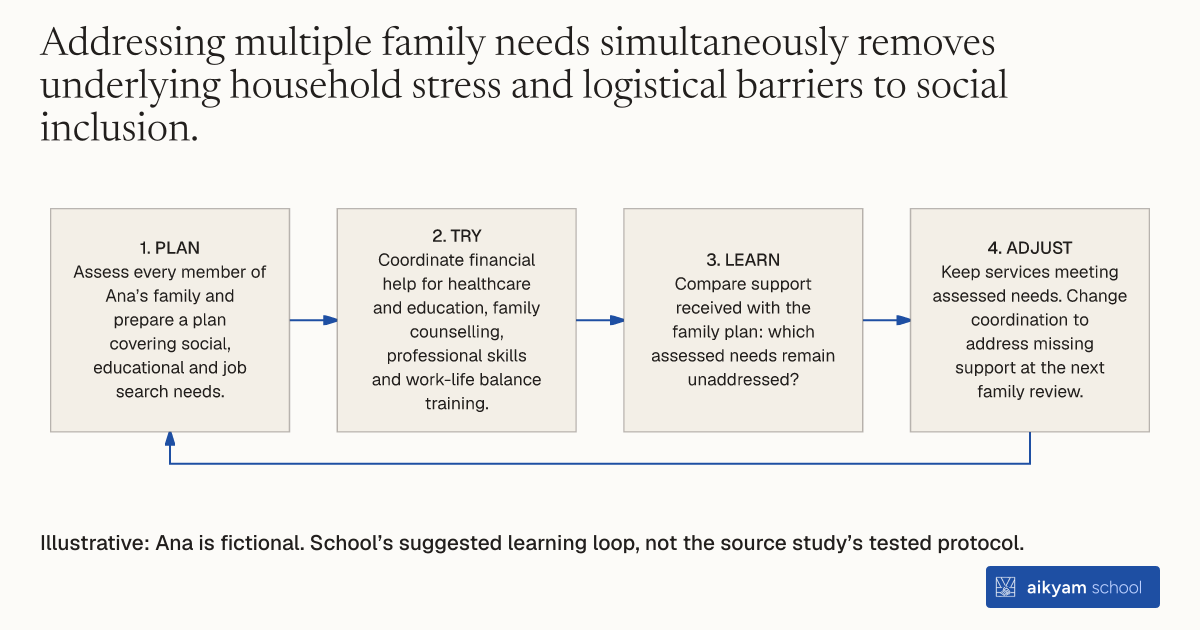
Try, learn and adjust
Check family support covers assessed needs
- Plan: Assess every member of Ana’s family and prepare a plan covering social, educational and job search needs.
- Try: Coordinate financial help for healthcare and education, family counselling, professional skills and work-life balance training.
- Learn: Compare support received with the family plan: which assessed needs remain unaddressed?
- Adjust: Keep services meeting assessed needs. Change coordination to address missing support at the next family review.
Illustrative: Ana is fictional. School’s suggested learning loop, not the source study’s tested protocol.
See source →School’s suggested, untested loop: observe family service access; short-term employment and earned income did not increase in the trial.
How
When to use
Low-income families receiving social assistance face multiple overlapping barriers to social and economic inclusion. Standard individual support programs often fail to address complex household needs like childcare, housing, and education. This method helps social service agencies deliver coordinated, multi-sectoral support to vulnerable households.
Deliver comprehensive social inclusion support to families through a single coordinated access point.
- Local social caseworkers perform an initial needs assessment for every member of an enrolled family.
- Caseworkers design a tailored multi-sectoral plan that connects family members to social, educational, and job search programs.
- Program staff provide financial assistance for healthcare and educational materials to improve household stability.
- Social workers deliver individual and group counselling covering parental skills, housing conditions, and family satisfaction.
- Employment counselors conduct group training sessions on professional skills and work-life balance.
Why it works
Coordinated assistance ensures family members receive targeted support across healthcare, education, and employment in a single unified plan.
Example
The Government of Galicia in Spain implemented a one-stop window program for 2,359 families receiving minimum income transfers. Local caseworkers assessed multi-sectoral family needs and provided coordinated counselling, financial aid, and skills training over nine months. Participating households achieved higher overall social inclusion, improved housing conditions, better parental skills, and reduced child material deprivation.
About the study
Participants
2,359 families (1,060 treatment group, 1,299 comparison group) receiving minimum income schemes in Galicia, Spain.
Study Design
Randomised Controlled Trial (RCT) evaluating a 9-month multi-sectoral one-stop shop inclusion intervention delivered by local non-governmental organisations.
Results
The program improved the overall synthetic indicator of social inclusion, housing conditions, parental skills, family satisfaction, community integration, education performance, and job search intensity, while reducing child material deprivation, but did not increase short-term earned income or employment rates.