Research procedure
Compare recurring outreach costs
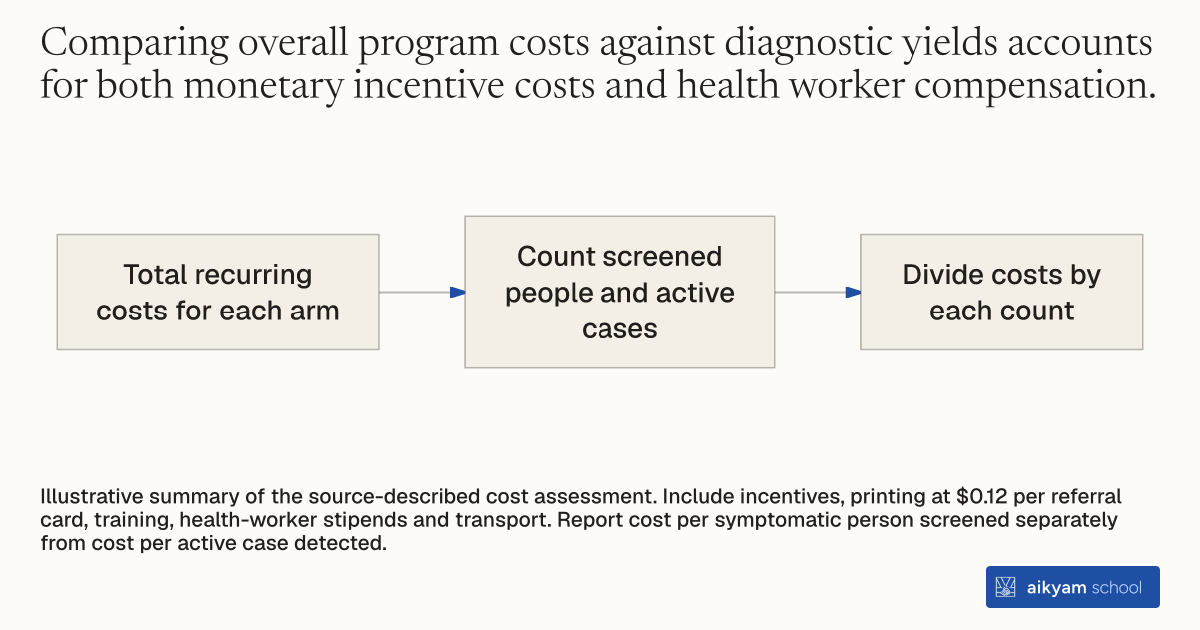
- Total recurring costs for each arm
- Count screened people and active cases
- Divide costs by each count
Illustrative summary of the source-described cost assessment. Include incentives, printing at $0.12 per referral card, training, health-worker stipends and transport. Report cost per symptomatic person screened separately from cost per active case detected.
See source →How
When to use
Public health agencies evaluating active case finding for tuberculosis face budget constraints and need to choose between peer referrals and health worker contact tracing. Traditional outreach strategies rely on paid health workers whose stipends make large-scale screening expensive. This assessment method evaluates recurring outreach costs to identify the most cost-effective approach for detecting undiagnosed infectious disease.
Calculate the average cost per symptomatic screened and per active case detected across recurring expenditure categories to evaluate active case finding programs.
- Track referral incentive payments disbursed to current patients based on study referral rules.
- Calculate referral card printing costs at \$0.12 per card across all issued card batches.
- Compute training time costs for explaining outreach schemes to current patients at local wage rates.
- Record health worker monthly stipends and transportation allowances paid for contact tracing.
- Sum total recurring expenses for each outreach arm across all health centers.
- Divide total arm costs by the number of symptomatics screened and active tuberculosis cases detected to determine unit detection costs.
Why it works
This reveals that low-cost financial incentives to peers generate higher case detection yields per dollar spent than salaried health worker visits.
Example
An evaluation across 122 health centers in India showed that peer outreach detected active tuberculosis cases at \$114 per case, compared to \$302 for anonymous health worker contact tracing and \$402 for identified health worker contact tracing.
About the study
Participants
3,176 tuberculosis patients at 122 DOTS clinics across 10 cities in India.
Study Design
Economic evaluation of recurring intervention expenses across randomized peer outreach and health-worker contact-tracing arms.
Results
Peer outreach screening cost \$14 per suspect screened and \$114 per active case detected, whereas health-worker contact tracing cost \$71–\$75 per suspect screened and \$302–\$402 per active case detected.