Research steps
Model campaign costs at larger scale
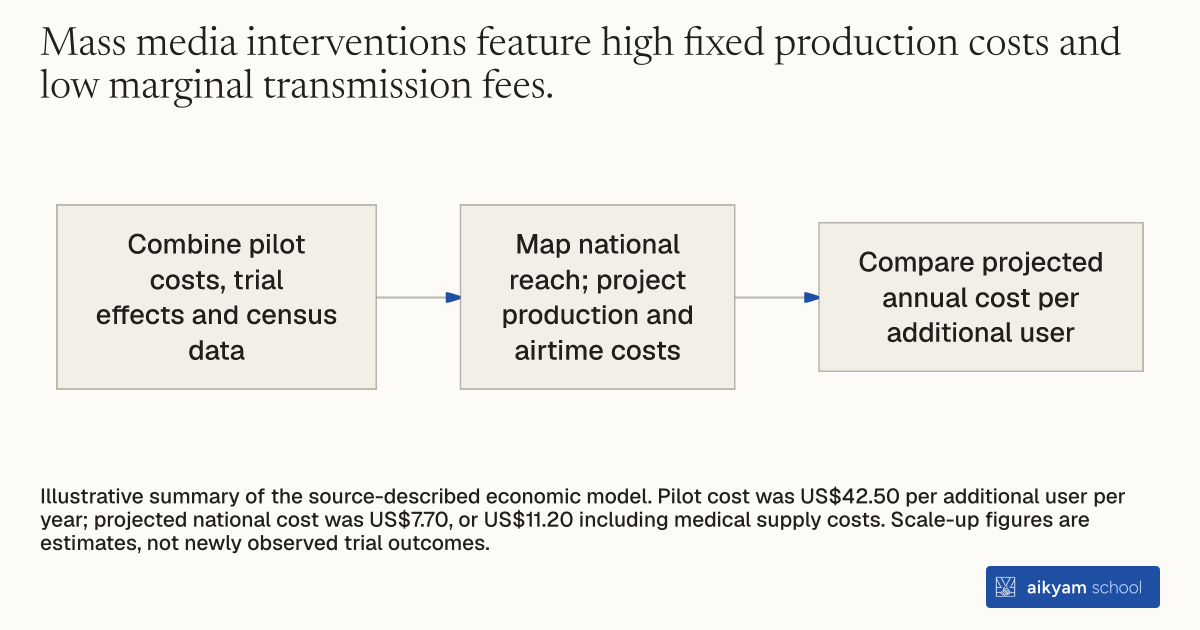
- Combine pilot costs, trial effects and census data
- Map national reach; project production and airtime costs
- Compare projected annual cost per additional user
Illustrative summary of the source-described economic model. Pilot cost was US$42.50 per additional user per year; projected national cost was US$7.70, or US$11.20 including medical supply costs. Scale-up figures are estimates, not newly observed trial outcomes.
See source →How
When to use
Public health organizations and funding agencies need to evaluate whether scaling up a regional mass media campaign across an entire country is economically viable. Simply measuring local pilot costs does not demonstrate long-term financial feasibility or enable comparison with alternative health interventions. Combining empirical treatment effect estimates with demographic census projections and operational expenditure data provides robust cost-effectiveness benchmarks for national scale-up decisions.
Combine trial treatment effects, national census data, and donor expenditure records to model program cost-effectiveness and national scale-up feasibility.
- Compile total pilot implementation costs from donor accounting records and convert expenditures to the baseline analysis currency year.
- Estimate the annual number of additional users resulting from the pilot campaign by multiplying the empirical treatment effect by the target census population in survey-representative zones.
- Calculate the pilot annual cost per additional user by dividing total pilot expenditures by the estimated number of new users over the effective program duration.
- Map national broadcast coverage across all planned expansion radio stations using signal propagation mapping to identify the national reach population.
- Project the scale-up budget required to expand broadcasting across national radio networks, separating fixed production costs from variable station transmission fees.
- Calculate the projected national cost per additional user and compare results against alternative health sector benchmarks and supply-side healthcare costs.
Why it works
Modeling nationwide scale-up demonstrates how expanding coverage across additional radio stations drastically reduces the cost per beneficiary while increasing overall health impact.
Example
In Burkina Faso, evaluators modeled the cost-effectiveness of Development Media International's family planning campaign. Expanding the pilot from 8 stations covering 5.1 million people to a national network of 39 stations covering 83 percent of the population increased total program costs modestly from 3,132,883 US dollars to 3,454,392 US dollars. This national scale-up increased the projected recipient population to 225,365 additional modern contraceptive users, dropping the annual cost per additional user from 42.50 US dollars to 7.70 US dollars.
About the study
Participants
5.1 million people across 16 pilot radio station clusters, expanding to 83 percent of Burkina Faso's population (3.8 million women of reproductive age) across 39 national stations.
Study Design
Economic cost-effectiveness and scale-up projection model combining cluster RCT impact estimates, 2006 national census population projections, and financial expenditure audits.
Results
Scaling the media campaign nationally reduced the annual cost per additional modern contraceptive user from 42.50 US dollars in the pilot to 7.70 US dollars (11.20 US dollars including medical supply costs), generating an estimated 225,365 additional users and roughly 10,000 averted births per year.