Research steps
Adjust predicted energy savings
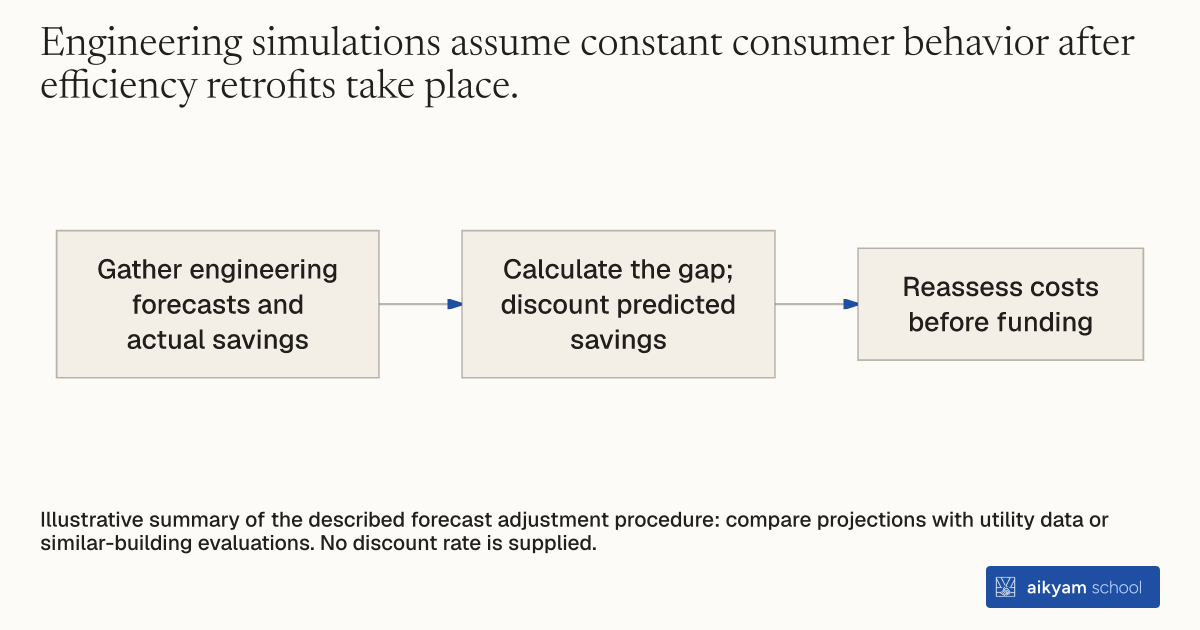
- Gather engineering forecasts and actual savings
- Calculate the gap; discount predicted savings
- Reassess costs before funding
Illustrative summary of the described forecast adjustment procedure: compare projections with utility data or similar-building evaluations. No discount rate is supplied.
See source →How
When to use
Ex-ante engineering models predict higher energy savings than households achieve after building upgrades. Inattentive consumers and price rebound effects lead households to increase energy usage when heating or cooling becomes cheaper. Program managers need to adjust predicted savings when planning building retrofit budgets.
Apply empirical discount factors to ex-ante engineering energy efficiency predictions before funding building decarbonization programs.
- Gather engineering projections of expected energy reductions for proposed home weatherization or space heating retrofits.
- Review local utility billing data or quasi-experimental evaluations from similar building types.
- Calculate the historical gap between predicted engineering savings and ex-post realized energy savings.
- Reduce predicted energy savings estimates by applying behavioral discount rates that account for household price rebound.
- Re-evaluate program cost-effectiveness using adjusted carbon abatement projections before disbursing funds.
Why it works
Discounting engineering estimates aligns budget projections with real household responses like increased thermostat usage.
Example
Evaluations of residential space heating and weatherization programs in the United States showed that actual energy reductions fell short of engineering predictions. These programs achieved real carbon abatement at costs of \$448 and \$505 per metric ton of CO2 avoided.
About the study
Participants
43 impact evaluations of single-family homeowners in the United States, United Kingdom, Switzerland, and Australia.
Study Design
26 quasi-experimental difference-in-differences models, 10 randomized controlled trials, and 7 regression discontinuity designs evaluating building retrofits.
Results
Ex-ante engineering simulations consistently overestimated ex-post realized energy savings across space heating, cooling, and weatherization retrofits, resulting in realized cost-effectiveness of \$448 and \$505 per metric ton of CO2 avoided for weatherization programs.