Research comparison
Compare landfill capture scenarios
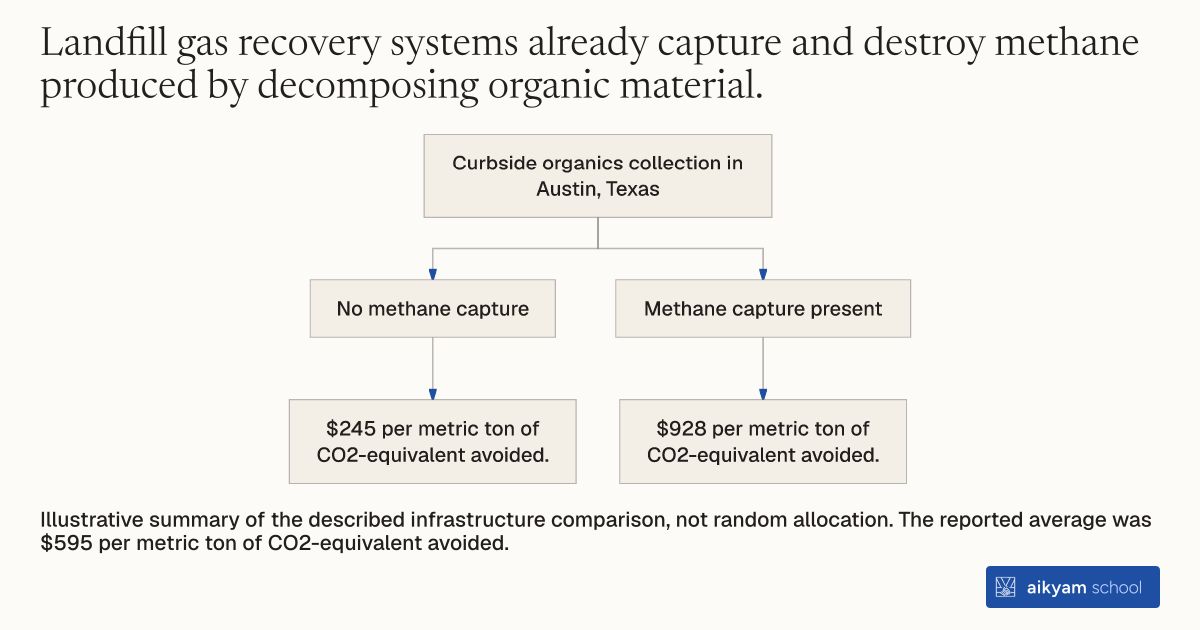
Curbside organics collection in Austin, Texas
- No methane capture
- $245 per metric ton of CO2-equivalent avoided.
- Methane capture present
- $928 per metric ton of CO2-equivalent avoided.
Illustrative summary of the described infrastructure comparison, not random allocation. The reported average was $595 per metric ton of CO2-equivalent avoided.
See source →How
When to use
Organics diversion programs aim to reduce landfill methane emissions by collecting organic waste at the curbside. Implementing curbside organics collection in municipalities where landfills already operate methane capture systems lowers the net carbon reduction per dollar spent. Municipal waste departments need to evaluate existing landfill methane technology before funding curbside organics programs.
Assess local landfill methane capture infrastructure before funding municipal curbside organics diversion programs.
- Waste management analysts inspect regional landfills to identify installed landfill gas recovery and flare systems.
- Program officers measure baseline methane capture efficiency at facilities receiving municipal solid waste.
- Analysts calculate projected net avoided emissions for proposed curbside organic waste collection streams.
- Program managers calculate cost-effectiveness metrics in dollars per metric ton of CO2-equivalent avoided under both capture and non-capture scenarios.
- Allocate organics diversion budgets to jurisdictions lacking landfill gas capture infrastructure to maximize net carbon abatement.
Why it works
Collecting organics separately in municipalities with active gas capture yields smaller marginal emissions reductions than in areas without gas capture.
Example
An evaluation of a curbside organics collection program in Austin, Texas evaluated cost-effectiveness across landfills with and without gas recovery. Curbside organics collection cost \$245 per metric ton of CO2-equivalent avoided without landfill methane capture, but cost \$928 per metric ton when methane capture was present.
About the study
Participants
Residential households participating in municipal curbside organics programs in Austin, Texas.
Study Design
Quasi-experimental evaluation comparing municipal waste diversion and landfill methane emissions across landfill infrastructure types.
Results
Curbside organics programs achieved an average cost-effectiveness of \$595 per metric ton of CO2-equivalent avoided, with cost-effectiveness varying from \$245 per metric ton without landfill methane capture to \$928 per metric ton when methane capture was present.