Research steps
Calculate weekly working hours from earnings
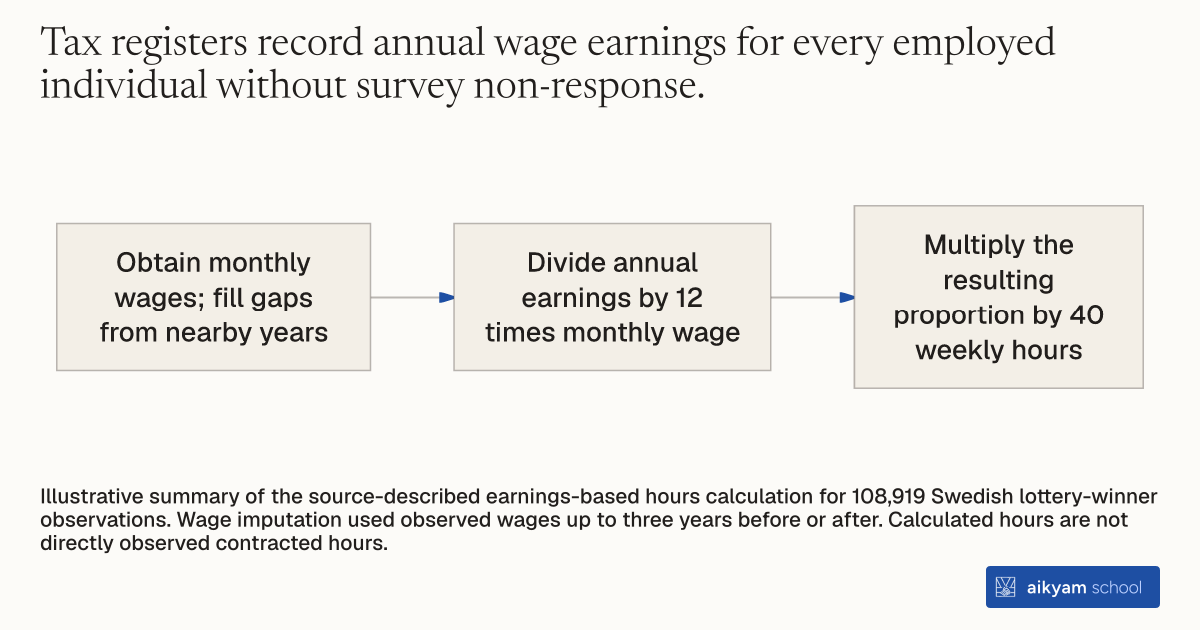
- Obtain monthly wages; fill gaps from nearby years
- Divide annual earnings by 12 times monthly wage
- Multiply the resulting proportion by 40 weekly hours
Illustrative summary of the source-described earnings-based hours calculation for 108,919 Swedish lottery-winner observations. Wage imputation used observed wages up to three years before or after. Calculated hours are not directly observed contracted hours.
See source →How
When to use
Researchers need to track weekly working hours across a full sample of workers over multiple years. Direct survey measures of contracted hours suffer from incomplete private-sector coverage and sample attrition when workers exit employment. Calculating working hours by combining population-wide tax register wage earnings with contracted survey wages overcomes missing hours data.
Calculate weekly hours worked by scaling baseline full-time hours by the ratio of annual register wage earnings to total annual contracted wages.
- Obtain contracted full-time equivalent monthly wages from employer annual wage survey records.
- Impute missing monthly wages for missing years using observed wages from adjacent years up to three years prior or three years after.
- Collect population-wide annual wage earnings for each individual from tax register records.
- Multiply contracted monthly wages by twelve to calculate total expected full-time annual wages.
- Divide actual annual register wage earnings by total expected full-time annual wages to determine full-time equivalent work proportions.
- Multiply forty weekly baseline hours by full-time equivalent work proportions to derive annual weekly hours worked.
Why it works
Combining register earnings with imputed survey wage rates allows accurate measurement of working hours even for individuals who work few hours or leave survey coverage.
Example
Researchers in Sweden calculated weekly hours worked for 108,919 lottery winner observations between 1991 and 2010 by combining Statistics Sweden annual wage survey records with population-wide tax register wage data.
About the study
Participants
108,919 observations of Swedish lottery winners aged 21 to 64 participating between 1991 and 2010.
Study Design
OLS panel regression estimating five-year weekly working hours adjustments per million SEK won using earnings-based imputed hours while controlling for lottery cell fixed effects.
Results
A 1M SEK lottery prize reduces calculated weekly working hours by 1.282 hours (p < 0.001), representing a 3.9 percent drop relative to the sample average of 32.8 weekly hours.