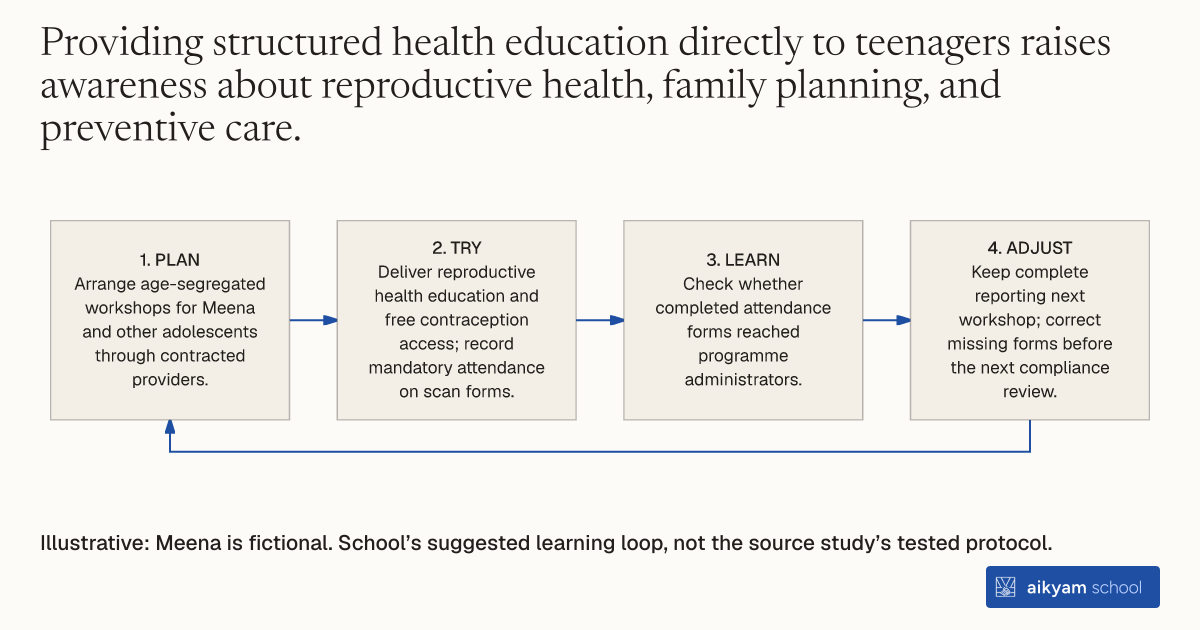
Try, learn and adjust
Check adolescent workshop attendance is recorded
- Plan: Arrange age-segregated workshops for Meena and other adolescents through contracted providers.
- Try: Deliver reproductive health education and free contraception access; record mandatory attendance on scan forms.
- Learn: Check whether completed attendance forms reached programme administrators.
- Adjust: Keep complete reporting next workshop; correct missing forms before the next compliance review.
Illustrative: Meena is fictional. School’s suggested learning loop, not the source study’s tested protocol.
See source →Workshop records and submission. This delivery check is not clinical guidance. School’s suggested learning loop, not a source-tested cycle.
How
When to use
Adolescents in rural communities often lack formal education regarding sexual development, family planning, and reproductive health. Early teenage years present a critical window when young women face risks of early pregnancy and early marriage. Conducting age-segregated reproductive health workshops and providing direct contraceptive access equips teenagers with vital health knowledge during early adolescence.
Deliver age-segregated health education workshops and modern contraceptive access to adolescents through contracted healthcare networks.
- Health educators organize specialized workshops focused on healthy living, reproductive biology, and modern contraception for local adolescents.
- Workshop facilitators divide teenage participants into separate peer groups based on age to ensure age-appropriate discussion.
- Contracted healthcare providers distribute modern contraceptive methods free of charge at health centers and mobile clinics.
- Program staff enforce mandatory workshop attendance for adolescents in active transfer communities as a condition for household cash payments.
- Healthcare providers record adolescent attendance on standardized scan forms and submit them to program administrators.
Why it works
Tying workshop attendance to household transfer eligibility ensures high participation among adolescents in target communities.
Example
In rural Nicaragua, the Red de Protección Social added mandatory adolescent reproductive health sessions and contraceptive access in 2003. Late-treatment girls who received the program during ages 11 to 14 attended workshops at significantly higher rates, with 82 percent attending compared to early-treatment peers whose cash transfers had ended.
About the study
Participants
809 young women aged 19 to 22 across 42 rural comarcas in six municipalities in central and northern Nicaragua.
Study Design
Clustered randomized phase-in comparison measuring the differential impact of mandatory adolescent reproductive health workshops between early treatment and late treatment cohorts.
Results
Mandatory adolescent workshop conditions in the late treatment group increased workshop attendance by 5.8 percentage points to 81.5 percent and increased knowledge of Pap tests by 6.3 percentage points compared to the early treatment group.