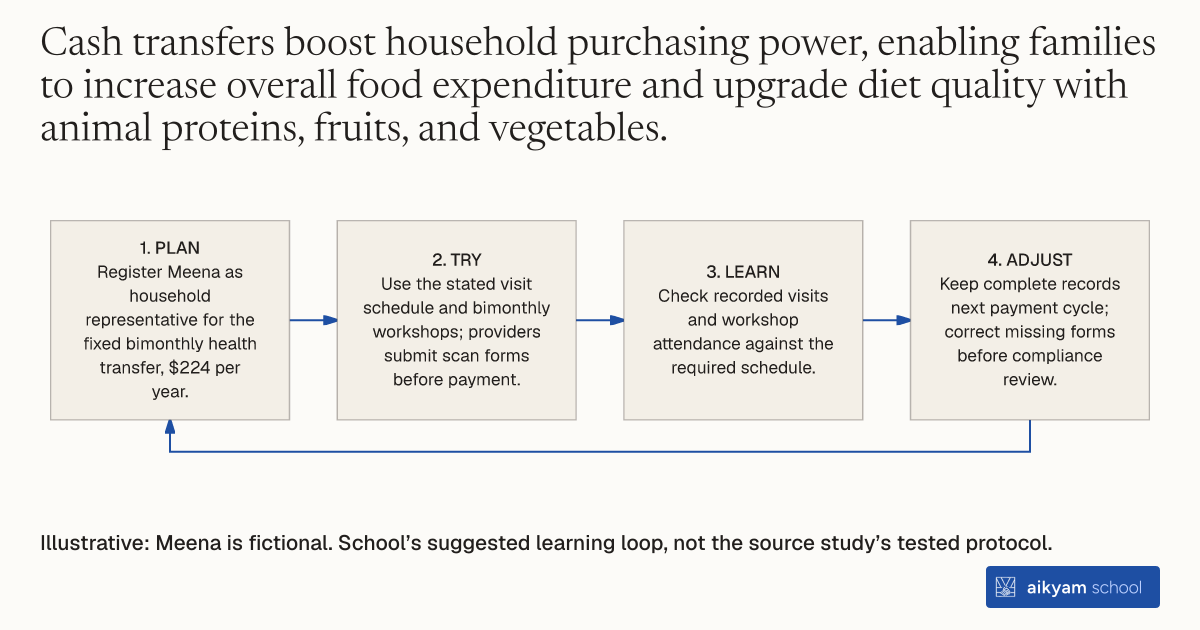
Try, learn and adjust
Check health-transfer compliance records are complete
- Plan: Register Meena as household representative for the fixed bimonthly health transfer, $224 per year.
- Try: Use the stated visit schedule and bimonthly workshops; providers submit scan forms before payment.
- Learn: Check recorded visits and workshop attendance against the required schedule.
- Adjust: Keep complete records next payment cycle; correct missing forms before compliance review.
Illustrative: Meena is fictional. School’s suggested learning loop, not the source study’s tested protocol.
See source →Monthly visits under age two; bimonthly visits at ages two to five and workshops. This is a delivery check, not clinical guidance. School’s suggested learning loop, not a source-tested cycle.
How
When to use
In impoverished rural areas, young children face high rates of undernutrition and inadequate preventive healthcare. Financial constraints prevent families from purchasing sufficient food and attending routine health checkups. Fixed household cash grants tied to health conditions incentivize parents to invest in nutrition and maintain preventive health schedules for young children.
Disburse a fixed bimonthly cash grant to beneficiary household representatives conditional on mandatory preventive healthcare visits for children under five and attendance at health education workshops.
- Program staff register eligible rural households, appointing the primary female caregiver as the designated representative to receive payments.
- Program administrators disburse a fixed bimonthly nutrition and health cash transfer of \$224 per year per household, regardless of household size.
- Household representatives bring infants under age two to contracted healthcare providers for monthly scheduled preventive health appointments.
- Household representatives bring children aged two to five to contracted healthcare providers for bimonthly preventive health visits that include growth monitoring, vaccinations, iron supplementation, and anti-parasite medication.
- Household representatives attend mandatory bimonthly health education workshops held within their communities.
- Program health providers record completed health visits and workshop attendance on standardized scan forms and submit them to the program office to verify compliance before payment release.
Why it works
Mandatory preventive health visits ensure young children receive regular growth monitoring, immunizations, and vital micronutrients during critical developmental years.
Example
In six rural Nicaraguan municipalities, the Red de Protección Social provided households in 21 early treatment comarcas with a \$224 annual health transfer starting in 2000. By 2002, beneficiary households increased per capita food consumption by 35 percent and significantly expanded expenditures on animal protein, fruits, and vegetables compared to late-treatment controls.
About the study
Participants
475 rural households with children across 42 comarcas in six municipalities in central and northern Nicaragua.
Study Design
Clustered randomized trial comparing early treatment households receiving transfers from 2000 to 2003 with late treatment control households phased in from 2003 to 2005.
Results
Two years of early program exposure increased household log per capita food consumption by 34.5 percent, increased the food expenditure share on animal protein by 5.4 percentage points and fruits and vegetables by 4.2 percentage points, and reduced the expenditure share on staples by 7.4 percentage points.