Try, learn and adjust
Check mobile service records reach the programme office
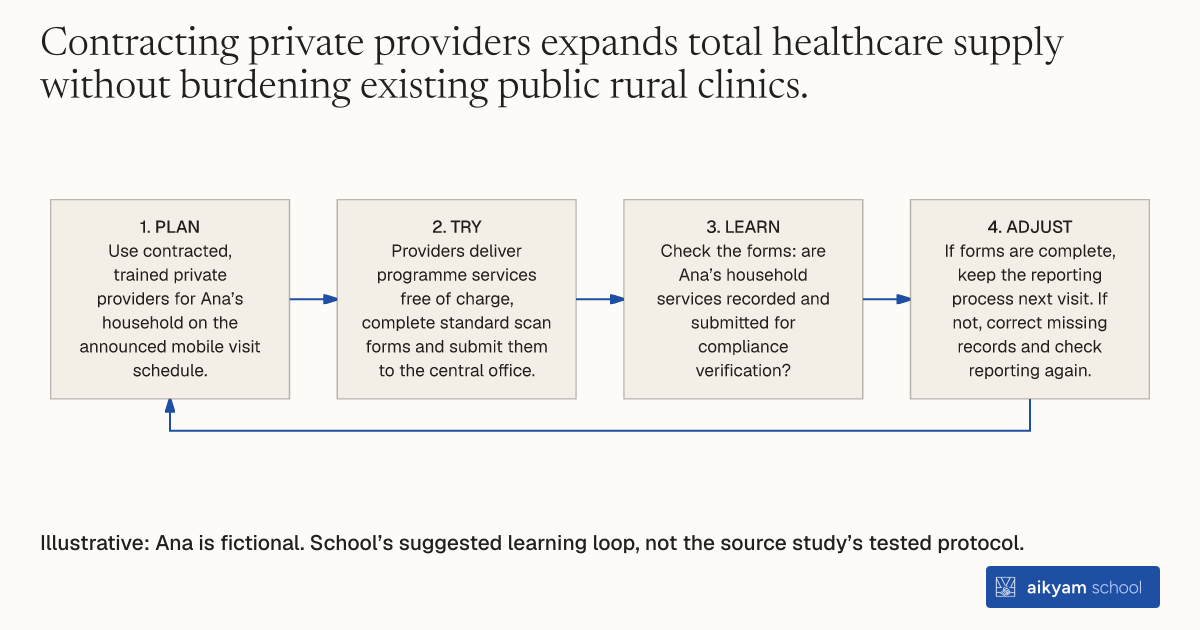
- Plan: Use contracted, trained private providers for Ana’s household on the announced mobile visit schedule.
- Try: Providers deliver programme services free of charge, complete standard scan forms and submit them to the central office.
- Learn: Check the forms: are Ana’s household services recorded and submitted for compliance verification?
- Adjust: If forms are complete, keep the reporting process next visit. If not, correct missing records and check reporting again.
Illustrative: Ana is fictional. School’s suggested learning loop, not the source study’s tested protocol.
See source →Observe service records, form submission and compliance verification. Do not infer health or cash-transfer effects from this check.
How
When to use
Public health clinics in isolated rural communities often lack doctors, medicines, and capacity to handle surging health service demands. Tying cash transfers to mandatory health visits can overwhelm weak local public clinics and degrade care quality. Contracting private healthcare teams to deliver mobile care directly within rural communities solves supply bottlenecks and fulfills program conditions.
Contract and train private healthcare providers to deliver scheduled mobile preventive care directly in rural communities free of charge.
- Program administrators select and contract private healthcare provider organizations to deliver specialized preventive healthcare services.
- Program administrators train contracted private healthcare personnel on program protocols, preventive care standards, and compliance reporting.
- Mobile healthcare teams travel to rural program localities on pre-announced, scheduled dates.
- Mobile healthcare providers deliver required services—including growth monitoring, vaccinations, iron supplements, and parasite treatment—in local health posts, community centers, or private homes.
- Contracted providers complete standardized scan forms recording every service delivered to individual children and household representatives.
- Healthcare teams submit completed scan forms to the program central office to verify beneficiary compliance and trigger transfer payments.
Why it works
Delivering mobile care directly in remote villages eliminates travel costs for beneficiaries and guarantees reliable care quality.
Example
In central and northern Nicaragua, the Red de Protección Social contracted private healthcare providers to service 42 rural comarcas starting in 2000. Mobile medical teams visited villages on fixed schedules to deliver preventive care for young children, contributing to a 35 percent increase in household food consumption and significant health gains across target communities.
About the study
Participants
Beneficiary households with children under five across 42 rural comarcas in six municipalities in central and northern Nicaragua.
Study Design
Randomized clustered evaluation where private healthcare providers were contracted to deliver supply-side health services in 21 early treatment localities from 2000 to 2003 and 21 late treatment localities from 2003 to 2005.
Results
Mobile private healthcare delivery met increased demand without reducing service quality, helping achieve high compliance that contributed to a 34.5 percent increase in per capita food consumption and a 0.27 grade increase in schooling.