Research steps
Rate candidate vote-buying activity
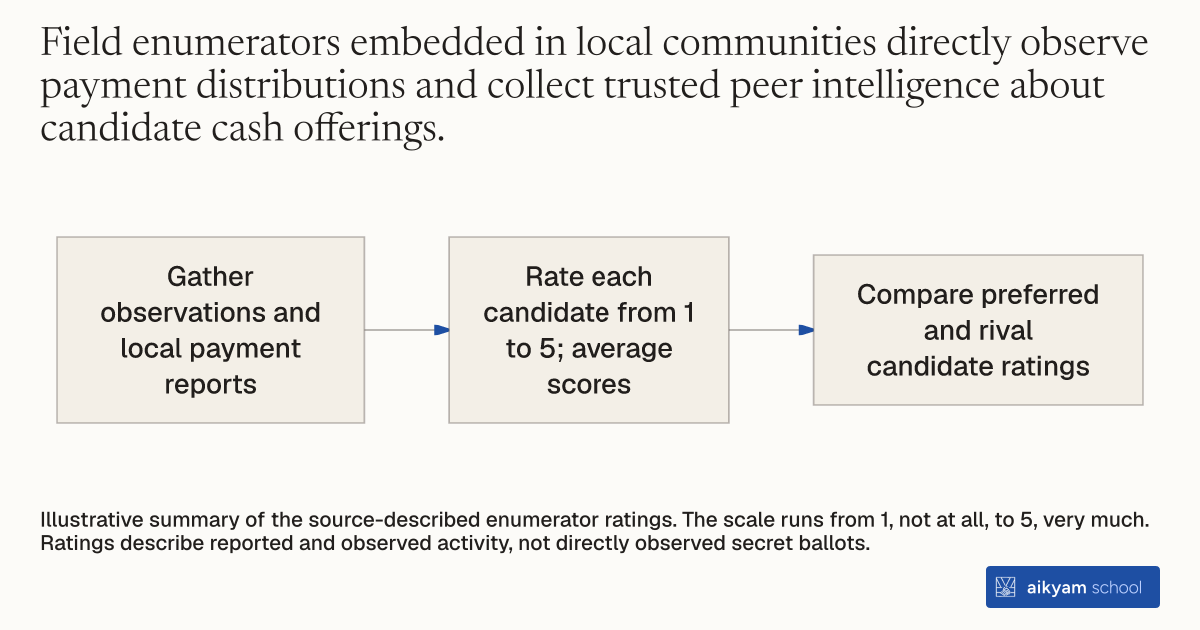
- Gather observations and local payment reports
- Rate each candidate from 1 to 5; average scores
- Compare preferred and rival candidate ratings
Illustrative summary of the source-described enumerator ratings. The scale runs from 1, not at all, to 5, very much. Ratings describe reported and observed activity, not directly observed secret ballots.
See source →How
When to use
Researchers and election monitoring organizations studying clientelism face unobserved, clandestine cash transfers by candidates to voters prior to election day. This method diagnoses the problem and intensity of candidate-level vote-buying in targeted electoral contests. It applies to survey enumerators monitoring municipal elections where informal vote-buying networks operate.
Rate candidate vote-buying activity on a standardized scale based on field observations and local informant reporting during an election campaign.
- Enumerators observe candidate cash offerings directly in electoral districts during the weeks leading up to an election.
- Enumerators gather field intelligence on payment amounts from friends and family members.
- Enumerators rate each candidate's vote-buying activity on a 5-point scale ranging from 1 for not at all to 5 for very much.
- Analysts calculate average vote-buying scores for candidates across mayoral, vice-mayoral, and city council races.
- Analysts calculate the vote-buying gap between a voter's preferred candidate and rival candidates to evaluate voter behavior.
Why it works
Standardized rating scales transform qualitative field reports into continuous quantitative metrics for evaluating vote-buying intensity.
Example
In Sorsogon City, Philippines, enumerators rated candidate vote-buying during the May 2013 municipal elections, finding mayoral candidates averaged 4.97, vice-mayoral candidates averaged 3.49, and city council candidates averaged 2.75.
About the study
Participants
883 surveyed households and candidates across mayoral, vice-mayoral, and city council elections in Sorsogon City, Philippines.
Study Design
Field rating methodology where enumerators scored candidate vote-buying on a 1-to-5 scale using direct observations and local reports, analyzed alongside voter panel survey data.
Results
Mayoral candidates received the highest average vote-buying rating at 4.97, vice-mayor candidates averaged 3.49, and city council candidates averaged 2.75 with a standard deviation of 0.78; a one-point larger vote-buying gap increased switching likelihood in any race by 23 percentage points.