Research procedure
Compile official precinct election records
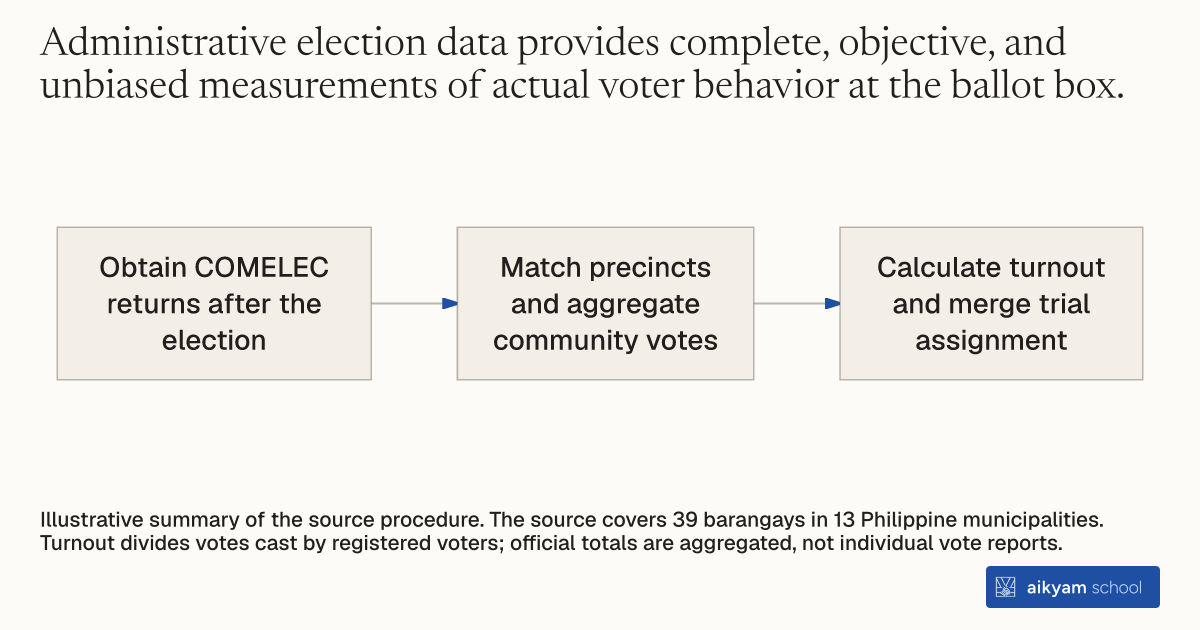
- Obtain COMELEC returns after the election
- Match precincts and aggregate community votes
- Calculate turnout and merge trial assignment
Illustrative summary of the source procedure. The source covers 39 barangays in 13 Philippine municipalities. Turnout divides votes cast by registered voters; official totals are aggregated, not individual vote reports.
See source →How
When to use
Researchers or policy evaluators need to measure actual voting behavior following an electoral intervention. Self-reported survey data on vote choices can suffer from social desirability bias, recall errors, or over-reporting. Collecting administrative election data directly at the precinct level provides objective, aggregated voting totals across study locations.
Collect official administrative voting records at the precinct level to evaluate electoral outcomes across experimental clusters.
- Obtain official precinct-level election returns directly from the national electoral commission following the election.
- Match every administrative precinct to its corresponding local community cluster using official geographic boundary maps.
- Aggregate total votes cast for each competing political party across all precincts within each community cluster.
- Calculate official turnout by dividing total votes cast by the total number of registered voters per precinct cluster.
- Merge precinct election totals with cluster assignment indicators to evaluate treatment impacts on official vote shares.
Why it works
Precinct-level aggregation eliminates respondent social desirability bias and reporting inaccuracies inherent in individual survey questionnaires.
Example
Following the May 2013 election in the Philippines, researchers obtained official precinct-level election returns from the Commission on Elections (COMELEC). They matched 39 barangays across 13 municipalities in Metro Manila and Calabarzon to their corresponding polling precincts, aggregating votes for national party-lists. The precinct data confirmed that deliberative town halls increased official party vote shares by 1.096 percentage points overall without significantly altering aggregate turnout.
About the study
Participants
Official COMELEC precinct-level election returns covering 39 barangays across 13 municipalities in Metro Manila and Calabarzon, Philippines.
Study Design
Precinct-level administrative data collection and aggregation matched to a two-stage cluster randomized field experiment design.
Results
Official COMELEC precinct data demonstrated that town halls increased party vote share by 1.096 percentage points (a 46 percent relative increase), while voter turnout remained unaffected at 77.2 percent in treatment areas versus 76.8 percent in control areas.