Research steps
Give advance notice of an agreement
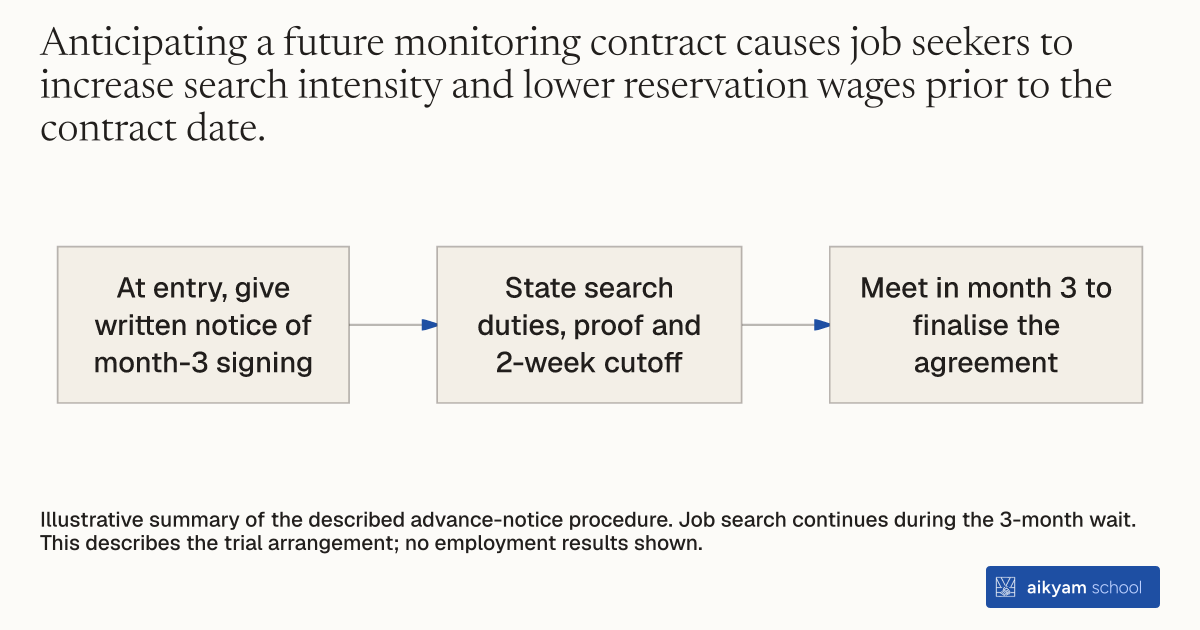
- At entry, give written notice of month-3 signing
- State search duties, proof and 2-week cutoff
- Meet in month 3 to finalise the agreement
Illustrative summary of the described advance-notice procedure. Job search continues during the 3-month wait. This describes the trial arrangement; no employment results shown.
See source →How
When to use
Newly registered job seekers enter unemployment insurance without knowing future compliance schedules. Sudden unannounced obligations can create abrupt behavioral jumps and scheduling friction. Providing written advance notice allows job seekers to anticipate upcoming search requirements and adjust their search efforts smoothly before the meeting.
Issue a detailed written information sheet during the initial consultation to inform a job seeker that a mandatory integration agreement will be signed in three months.
- Hand out the written information sheet during the first meeting upon entry into unemployment insurance.
- Outline the future contract date, required monthly application targets, and verification procedures in the notice.
- State explicitly in the document that non-compliance with the future agreement triggers a mandatory two-week benefit cutoff.
- Instruct the job seeker to maintain active job search efforts during the three-month period leading up to the contract meeting.
- Convene the contract signing meeting three months after unemployment entry to finalize the formal agreement.
Why it works
This smooths the transition to employment by avoiding abrupt behavior shifts when the contract date arrives.
Example
In five regional employment agencies in Germany, 1,013 unemployed men received a written notice at entry stating that an agreement would be signed in month three. Job seekers who received advance notice adjusted their exit rates to work more smoothly around day 90 compared to non-notified job seekers, though total 365-day re-employment rates remained similar at 68.3% versus 69.7%.
About the study
Participants
1,013 male unemployment insurance benefit recipients aged 25 to 64 in Germany assigned to treatment arm B (compared to 1,068 in arm C).
Study Design
Individual-level randomized controlled trial comparing notified and non-notified three-month contract groups, measuring empirical hazard slopes around day 90 and 365-day re-employment probabilities.
Results
Non-notified job seekers experienced a sharper increase in the job exit rate around day 90 than advance-notified job seekers, while 365-day re-employment probabilities were 68.3% for the notified group and 69.7% for the non-notified group.