Research steps
Delay agreement until month 6
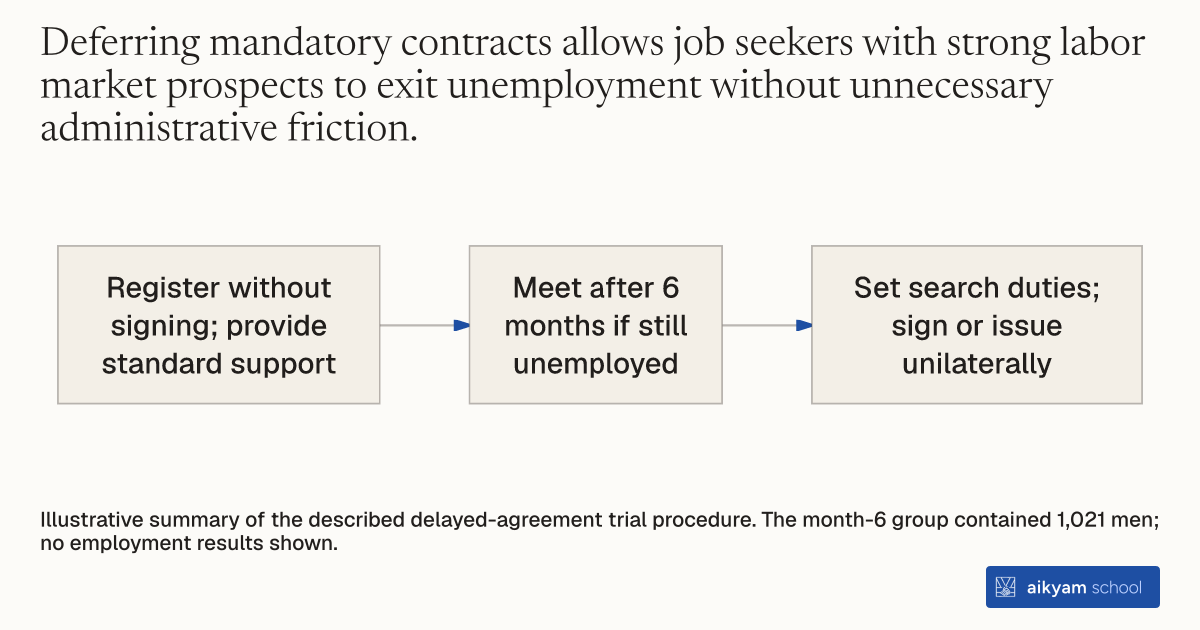
- Register without signing; provide standard support
- Meet after 6 months if still unemployed
- Set search duties; sign or issue unilaterally
Illustrative summary of the described delayed-agreement trial procedure. The month-6 group contained 1,021 men; no employment results shown.
See source →How
When to use
Newly registered job seekers enter unemployment insurance and may find work on their own during early months. Mandatory contracts impose administrative burden on caseworkers and job seekers if applied immediately at entry. Postponing formal contract execution until six months of elapsed unemployment reserves mandatory agreements for individuals remaining in long-term unemployment.
Delay formal integration agreement execution until an unemployed job seeker remains without work after six months of unemployment.
- Conduct initial intake and register the newly unemployed individual in agency placement software without signing an agreement.
- Provide standard job placement services and support during the first five months of unemployment.
- Schedule a formal consultation meeting when the job seeker reaches six months of continuous unemployment.
- Draft a binding integration agreement establishing minimum monthly job applications and verification requirements.
- Sign the contract with the job seeker or issue it unilaterally if the job seeker refuses to sign.
Why it works
Reserving agreements for month six focuses contractual monitoring specifically on workers who develop or exhibit longer unemployment spells.
Example
In five regional employment agencies in Germany, 1,021 unemployed men were assigned to have their agreement delayed until month six. Unemployed workers with low employability in this delayed group reached a 1-year re-employment rate of only 45%, compared to 53% for those receiving early agreements in month one.
About the study
Participants
1,021 male unemployment insurance benefit recipients aged 25 to 64 in Germany assigned to treatment arm D (compared to 1,061 in arm A, 1,013 in arm B, and 1,068 in arm C).
Study Design
Individual-level randomized controlled trial comparing delayed six-month contract signing against early contract arms (months 1 and 3) using administrative social security register data.
Results
Delaying contract execution until month six reduced the 1-year re-employment rate for low-employability job seekers from 53% (early month 1 arm) to 45%, while overall 1-year re-employment fell from 69% to 65%.