Research steps
Record the stated sanction process
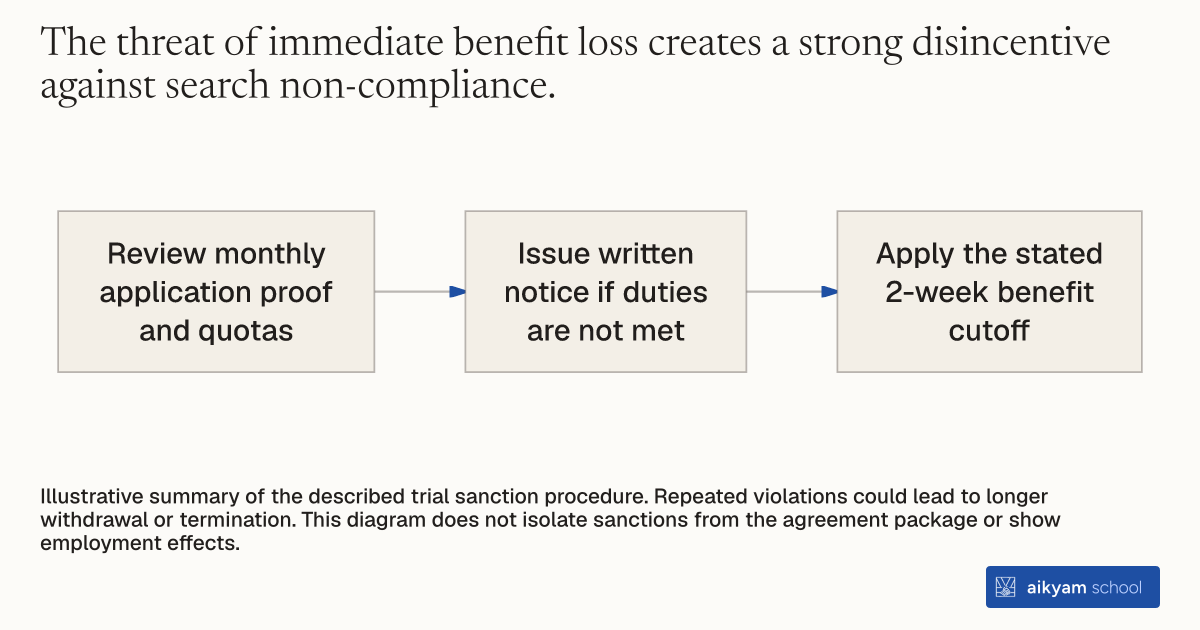
- Review monthly application proof and quotas
- Issue written notice if duties are not met
- Apply the stated 2-week benefit cutoff
Illustrative summary of the described trial sanction procedure. Repeated violations could lead to longer withdrawal or termination. This diagram does not isolate sanctions from the agreement package or show employment effects.
See source →How
When to use
Newly registered unemployed job seekers may fail to fulfill agreed job search obligations. Relying solely on voluntary compliance allows some individuals to delay active job search. Imposing financial benefit cutoffs enforces compliance when job seekers do not complete required search activities on time.
Enforce statutory benefit cuts when an unemployed job seeker fails to submit required job search proof or satisfy agreed application targets.
- Monitor whether the job seeker submits application logs by the required monthly deadline.
- Review submitted proof to verify that required application quotas and geographic requirements are satisfied.
- Issue a formal written notice of non-compliance if the job seeker fails to submit proof on time or completes insufficient applications.
- Apply a mandatory two-week benefit cutoff that temporarily suspends unemployment benefit payments.
- Extend benefit withdrawal for longer periods or terminate benefit entitlement entirely if repeated search violations occur.
Why it works
Job seekers increase their search effort and adjust their reservation wages to avoid financial penalties.
Example
In five regional employment agencies in Germany, caseworkers enforced benefit cutoffs against unemployed men who failed to meet search duties specified in mandatory agreements. Across 4,163 trial participants, early integration agreements backed by sanction threats increased one-year re-employment from 45% to 53% among low-employability job seekers.
About the study
Participants
4,163 male unemployment insurance benefit recipients aged 25 to 64 across five regional employment agencies in Germany.
Study Design
Individual-level randomized controlled trial evaluating integration agreements with statutory sanction mechanisms using administrative register data.
Results
Early agreements with benefit cutoff sanctions increased 1-year re-employment probabilities for low-employability job seekers from 45% to 53%, while overall 1-year re-employment rose from 65% to 69%.