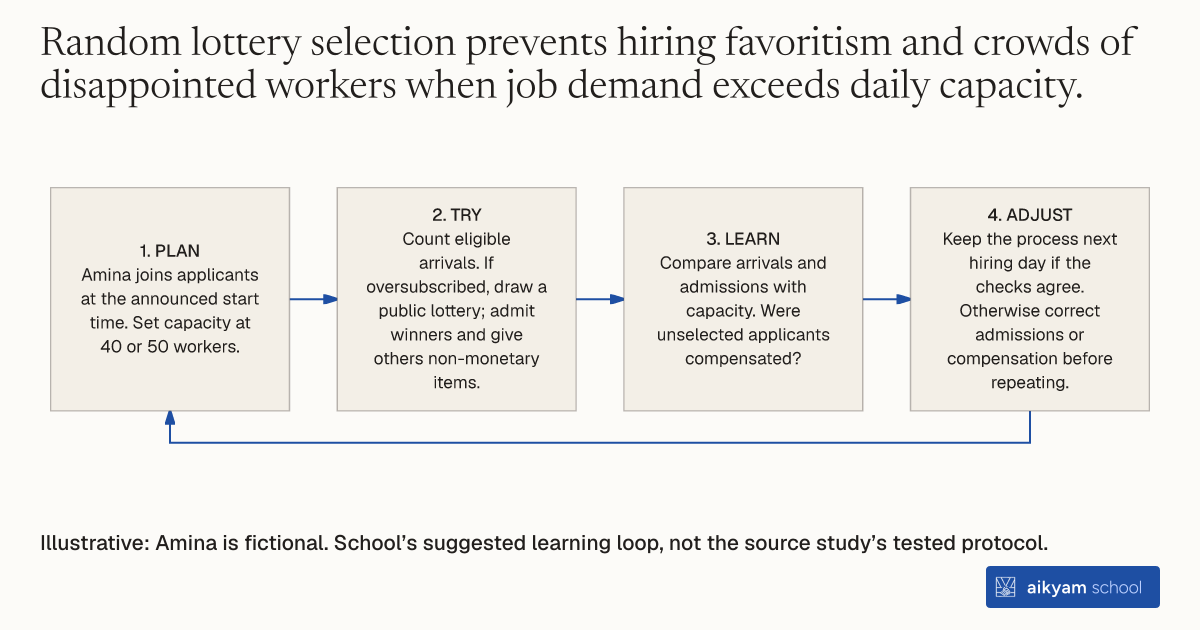
Try, learn and adjust
Check daily hiring against site capacity
- Plan: Amina joins applicants at the announced start time. Set capacity at 40 or 50 workers.
- Try: Count eligible arrivals. If oversubscribed, draw a public lottery; admit winners and give others non-monetary items.
- Learn: Compare arrivals and admissions with capacity. Were unselected applicants compensated?
- Adjust: Keep the process next hiring day if the checks agree. Otherwise correct admissions or compensation before repeating.
Illustrative: Amina is fictional. School’s suggested learning loop, not the source study’s tested protocol.
See source →School’s suggested learning loop: observe eligible arrivals, admissions and compensation; this is a delivery check.
How
When to use
Job openings in casual labor programs are frequently oversubscribed by local workers, creating potential bias if managers choose candidates subjectively. Rationing limited daily work slots through a transparent random draw maintains hiring fairness and prevents community conflict. This method suits field program directors managing oversubscribed daily employment sites.
Allocate limited daily casual labor contracts among oversubscribed job applicants using a transparent morning lottery.
- Establish a daily participant hiring limit of 40 or 50 workers based on field site management capacity.
- Require all interested local job candidates to gather at the central work site by a set start time.
- Count the total number of eligible job applicants present at the start time.
- Conduct a public random lottery draw whenever applicant attendance exceeds the site's daily participant cap.
- Admit the winning lottery participants into the daily contract exercise up to the capacity limit.
- Compensate non-selected applicants immediately with non-monetary items, such as soap, to offset their time costs.
Why it works
Distributing small non-monetary items to unselected applicants preserves community goodwill and encourages steady future participation.
Example
Field researchers in rural Malawi used daily lotteries across 12 villages to manage oversubscribed bean-sorting jobs. With an average of 52.9 eligible workers showing up each morning for 40 to 50 available slots, lotteries were required on 15 of 24 days during the low season and all 24 days during the high season. Unselected applicants received a bar of soap for showing up on time, maintaining community trust across the study.
About the study
Participants
689 participants across 12 villages in rural Malawi (66.5% female, average age 34.9 years) participating across 1,875 daily attendance decisions.
Study Design
Morning lottery allocation implemented across 48 operational experiment days whenever total arriving applicants exceeded daily site capacity (40 or 50 participants).
Results
Daily applicant arrival averaged 52.9 individuals (48.5 in the low season and 57.3 in the high season), triggering lotteries on 39 out of 48 total study days.