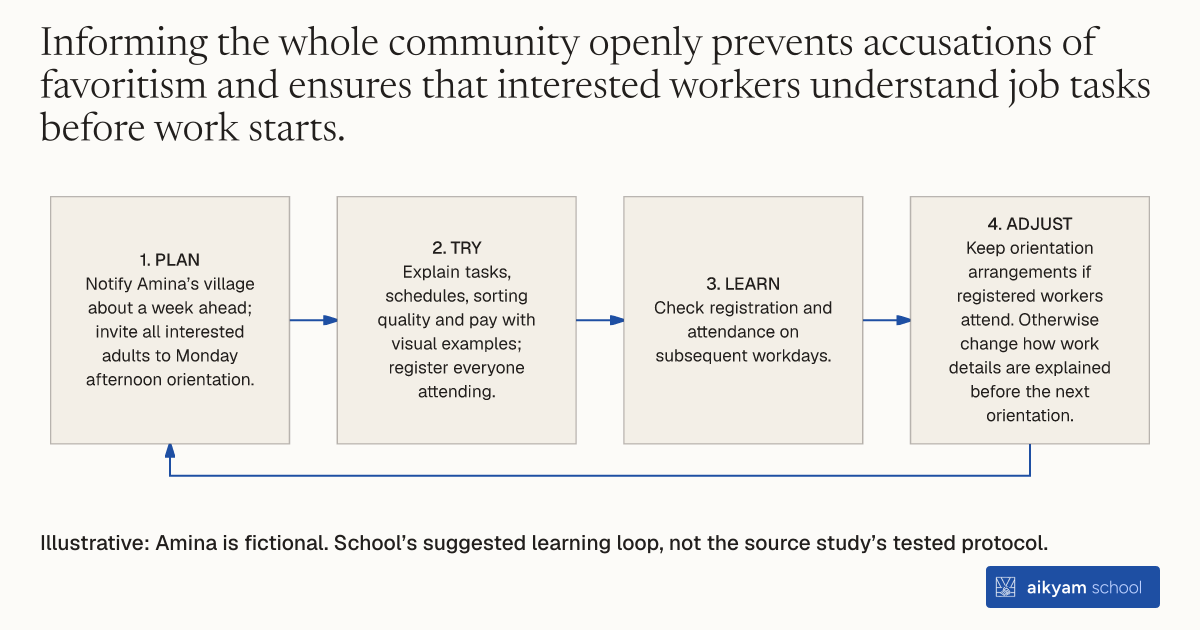
Try, learn and adjust
Check orientation registration and work attendance
- Plan: Notify Amina’s village about a week ahead; invite all interested adults to Monday afternoon orientation.
- Try: Explain tasks, schedules, sorting quality and pay with visual examples; register everyone attending.
- Learn: Check registration and attendance on subsequent workdays.
- Adjust: Keep orientation arrangements if registered workers attend. Otherwise change how work details are explained before the next orientation.
Illustrative: Amina is fictional. School’s suggested learning loop, not the source study’s tested protocol.
See source →School’s suggested learning loop, not the source’s tested procedure. Observe registration and daily attendance. The source registered 689 adults across 12 Malawi villages before four days of work.
How
When to use
Recruiting casual workers in rural communities requires clear communication of task requirements and payment rules before hiring begins. Unclear job terms create confusion, low attendance, and community mistrust during project rollouts. Open village orientation sessions establish local awareness and build an eligible recruitment pool for casual employment programs.
Recruit and prepare casual labor participants by conducting open community orientation sessions prior to work activities.
- Inform local village leaders and community members about upcoming work opportunities approximately one week in advance.
- Issue an open invitation to all interested adult residents to attend a group orientation session on a Monday afternoon.
- Explain the daily job tasks, work schedule, and sorting quality expectations at a central village meeting location.
- Show visual reference examples of accepted product categories and demonstrate the compensation rules to attendees.
- Formally register all attending community members to create an eligible pool of participants for subsequent workdays.
Why it works
Registering attendees in advance establishes an organized participant pool for subsequent daily lottery draws and hiring rounds.
Example
Field researchers conducted open Monday afternoon orientation sessions across 12 rural villages in Central Malawi prior to four-day bean sorting operations. The orientation sessions successfully registered 689 adult participants (66.5 percent female, mean age 34.9 years) across the 12 villages, creating an eligible workforce for subsequent daily contract draws.
About the study
Participants
689 registered participants across 12 villages in rural Malawi (66.5% female, mean age 34.9 years).
Study Design
Open community recruitment and training sessions held on Monday afternoons, registering eligible community members prior to four consecutive days of casual labor contracts.
Results
Orientation sessions generated average daily attendance of 52.9 eligible workers per village morning, successfully recruiting 355 participants in the low labor demand season and 334 in the high season.