Research steps
Recruit workers through village visits
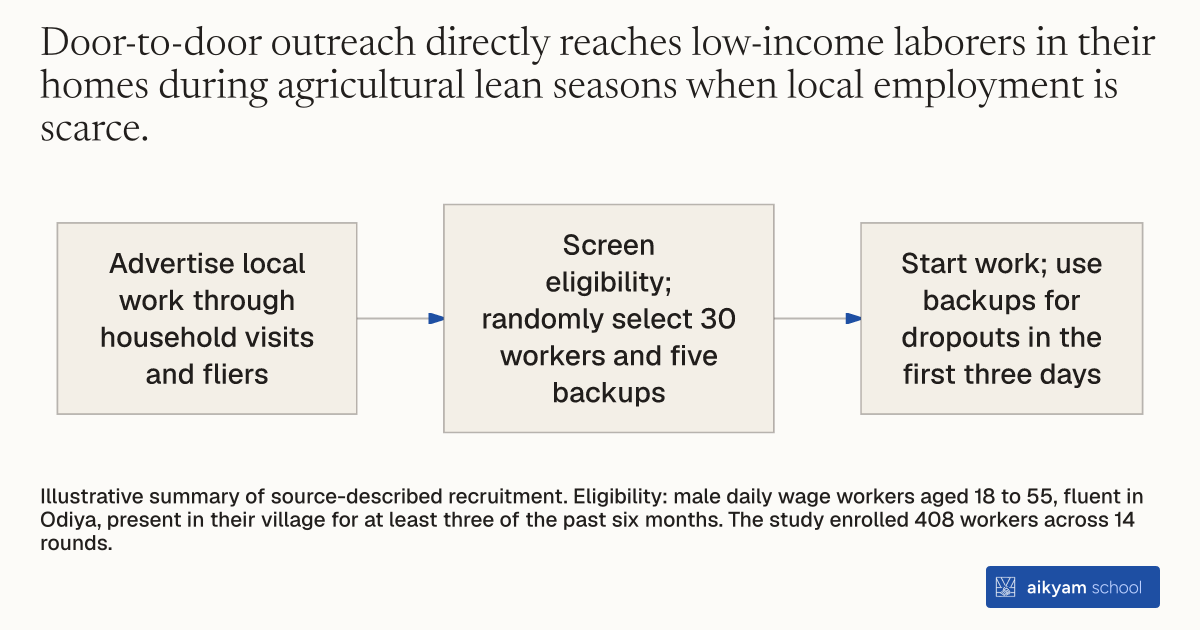
- Advertise local work through household visits and fliers
- Screen eligibility; randomly select 30 workers and five backups
- Start work; use backups for dropouts in the first three days
Illustrative summary of source-described recruitment. Eligibility: male daily wage workers aged 18 to 55, fluent in Odiya, present in their village for at least three of the past six months. The study enrolled 408 workers across 14 rounds.
See source →How
When to use
Recruit low-income casual laborers for temporary manufacturing or research work during seasonal agricultural lulls. It resolves the challenge of finding willing, eligible local workers without relying on formal job postings or labor brokers. It serves research projects or local contractors needing a representative sample of daily wage laborers within commuting distance.
Recruit eligible male wage laborers for temporary contract employment by conducting direct household outreach in target villages.
- Recruiters visit new target villages within daily commuting distance of the worksite a few days before a work round begins.
- Recruiters advertise the upcoming work opportunity through door-to-door household visits and fliers, specifying job location, manufacturing tasks, duration, and potential compensation.
- Recruiters screen interested villagers against eligibility criteria: aged between 18 and 55, fluent in Odiya, working regularly as daily wage laborers, and present in their home village for at least 3 of the past 6 months.
- Recruiters compile a sign-up list of eligible candidates and randomly select 30 workers per experimental round alongside 5 backup participants.
- Recruiters assign selected workers to start work at the facility, using backup participants during the first three days if any participant drops out.
Why it works
Random selection from sign-up lists avoids hiring bias and ensures a representative group of daily wage workers.
Example
Recruiters visited 47 target villages across four districts in rural Odisha, India, advertising two-week piece-rate jobs making sal leaf plates. Out of interested villagers, 408 male daily wage workers aged 18 to 55 were enrolled across 14 experimental rounds of roughly 30 workers each, with only 6 workers dropping out before contract completion.
About the study
Participants
408 male casual wage laborers aged 18 to 55 (mean age 39.2) drawn from 47 villages in Odisha, India, where 72% relied on daily labor as primary income and 86% faced baseline financial worry.
Study Design
Door-to-door village advertising and flier distribution followed by random selection from sign-up lists to fill 14 experimental rounds of 26 to 30 workers each, supplemented by 5 backup participants per round for early dropouts.
Results
Enrolled 408 workers across 14 rounds with a 98.5% contract completion rate and high daily attendance averaging 98.3%.