Survey classification
Classify seed reuse by the stated threshold
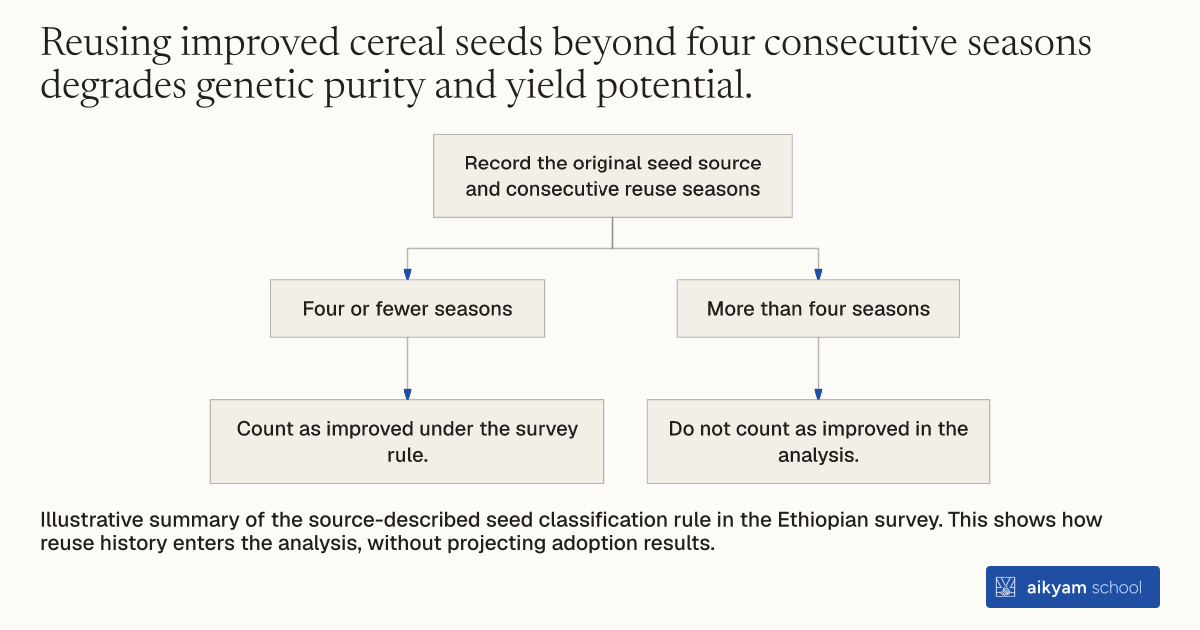
Record the original seed source and consecutive reuse seasons
- Four or fewer seasons
- Count as improved under the survey rule.
- More than four seasons
- Do not count as improved in the analysis.
Illustrative summary of the source-described seed classification rule in the Ethiopian survey. This shows how reuse history enters the analysis, without projecting adoption results.
See source →How
When to use
Smallholder farmers routinely recycle and share improved cereal seeds across multiple harvest cycles. Over successive generations, key genetic traits and disease resistance degrade, causing recycled seeds to perform like traditional varieties. Implementing a generational tracking protocol during agricultural surveys prevents overestimating true improved seed adoption rates.
Track cereal seed origins and reuse durations during farm surveys to classify seeds based on genetic quality thresholds.
- Administer structured survey questions asking household heads for the original acquisition source of planted crop seeds.
- Record the exact number of consecutive cropping seasons the household has re-harvested and replanted the same seed lot.
- Apply a four-season threshold rule to determine seed genetic classification.
- Categorize seeds reused for four or fewer cropping seasons as genuine improved seeds.
- Disqualify seeds reused for more than four seasons from being classified as improved seeds in impact evaluations.
Why it works
Disqualifying older recycled seeds ensures survey metrics reflect true access to productive genetic inputs rather than degraded varieties.
Example
In the endline survey across 2,382 smallholder households in Amhara, Oromia, and Tigray in Ethiopia, enumerators recorded seed origins and recycling years for wheat, maize, teff, barley, and sorghum. Excluding seeds reused past four generations adjusted the measured endline improved seed adoption rates to 57.4 percent in control communities, 63.9 percent under extension alone, and 63.8 percent under extension plus video.
About the study
Participants
N = 2,382 smallholder farming households across 201 microwatersheds in Ethiopia.
Study Design
Survey data verification protocol embedded in a cluster Randomized Controlled Trial to eliminate measurement error in self-reported improved seed adoption.
Results
Following generational verification, assignment to extension alone (T1) increased improved seed adoption by 6.5 percentage points (p = 0.027), while extension plus video (T2) increased adoption by 12.9 percentage points (p = 0.027) relative to the control mean of 57.4 percent.