Research procedure
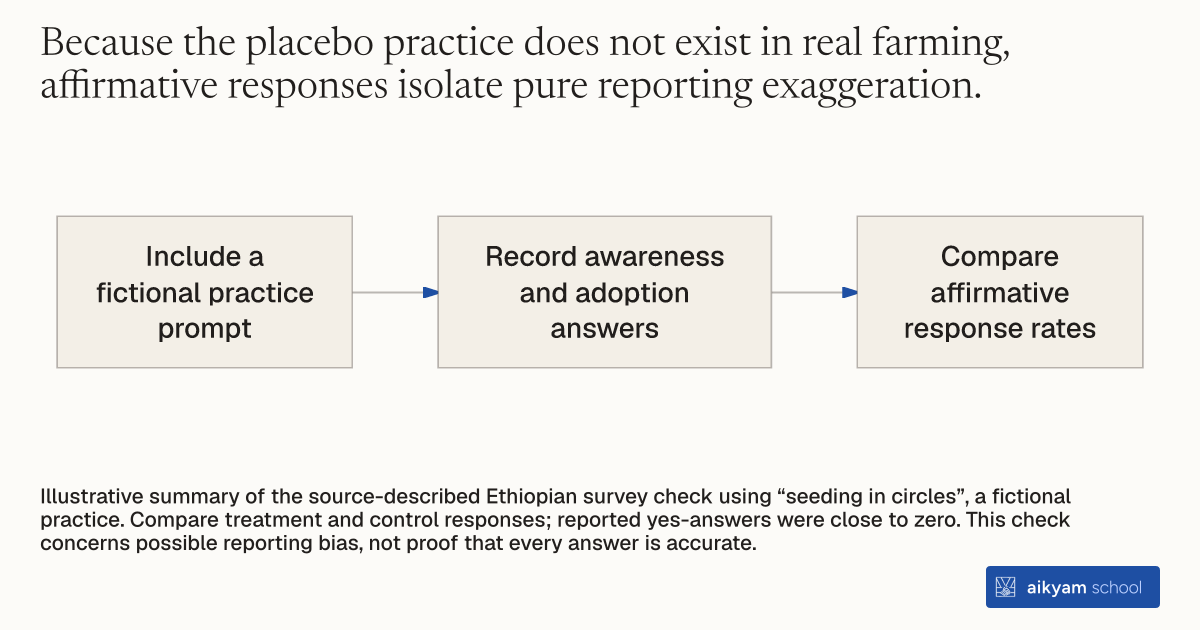
Check responses to a fictional practice
- Include a fictional practice prompt
- Record awareness and adoption answers
- Compare affirmative response rates
Illustrative summary of the source-described Ethiopian survey check using “seeding in circles”, a fictional practice. Compare treatment and control responses; reported yes-answers were close to zero. This check concerns possible reporting bias, not proof that every answer is accurate.
See source →How
When to use
Agricultural extension evaluations often rely on self-reported farmer survey data, which is vulnerable to acquiescence or social desirability bias. Respondents may claim to adopt non-existent or unrecommended practices to please enumerators. Including a fake practice in knowledge and adoption rosters detects whether survey respondents exaggerate technical usage.
Insert a plausible but entirely fabricated practice into survey lists to test and quantify respondent reporting bias.
- Design a fictive agricultural practice name, such as seeding in circles, that sounds plausible but is agronomic nonsense.
- Read the prompt listing the fictional practice alongside genuine agricultural technologies during survey interviews.
- Record respondent answers regarding awareness or self-reported adoption of the fabricated technique.
- Calculate the proportion of affirmative responses across survey treatment and control groups.
- Confirm survey data validity if positive responses to the placebo practice remain close to zero.
Why it works
Near-zero adoption claims prove that farmers are answering honestly rather than agreeing blindly to impress enumerators.
Example
During the endline survey of 2,382 smallholders across Amhara, Oromia, and Tigray in Ethiopia, enumerators included the placebo practice "seeding in circles" on the technology prompt list. Yes-answers were close to zero across all treatment arms, verifying that self-reported adoption increases were not driven by social desirability bias.
About the study
Participants
N = 2,382 smallholder farming households across 201 microwatersheds in Ethiopia.
Study Design
Methodological survey verification protocol within a cluster Randomized Controlled Trial using an open-ended/prompted roster containing a placebo practice.
Results
Affirmative response rates for the placebo practice ("seeding in circles") were close to zero, confirming negligible social desirability bias in self-reported technology adoption metrics.