Research procedure
Verify reported farm inputs physically
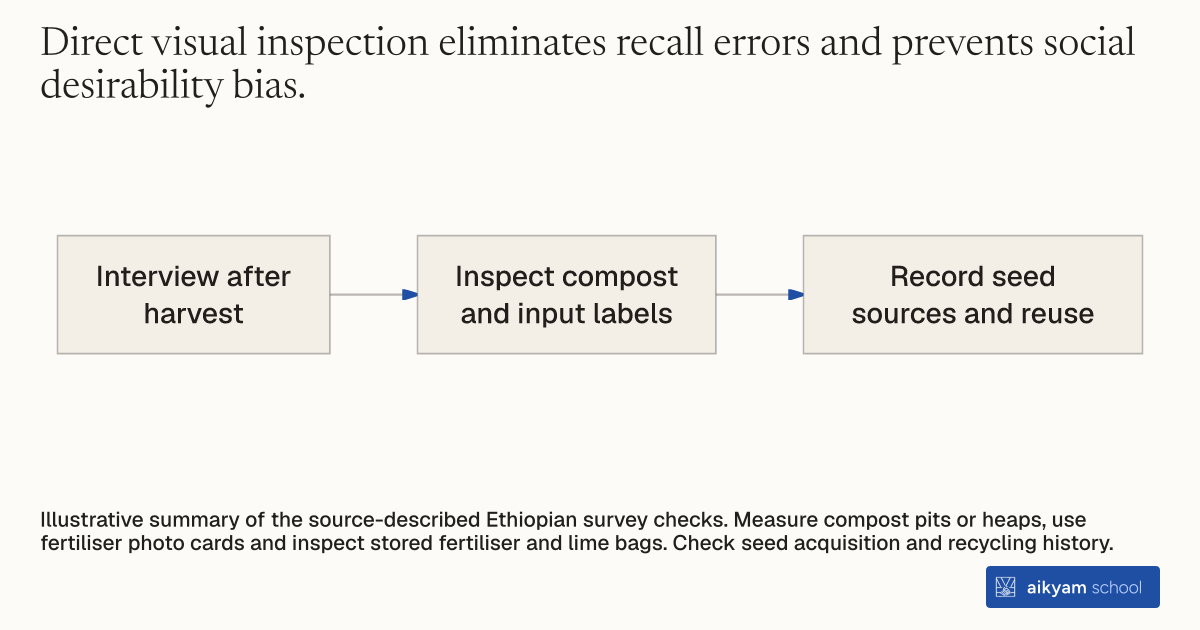
- Interview after harvest
- Inspect compost and input labels
- Record seed sources and reuse
Illustrative summary of the source-described Ethiopian survey checks. Measure compost pits or heaps, use fertiliser photo cards and inspect stored fertiliser and lime bags. Check seed acquisition and recycling history.
See source →How
When to use
Agricultural surveys frequently suffer from reporting bias when measuring smallholder technology adoption. Farmers often give social desirability answers or struggle to recall specific input names accurately. Direct physical inspection verifies self-reported input adoption to ensure reliable data in impact evaluations.
Inspect physical inputs, packaging labels, and production sites during farm survey interviews to verify self-reported agricultural practice adoption.
- Station trained enumerators at smallholder homesteads to conduct face-to-face tablet interviews after the harvest cycle.
- Direct enumerators to walk to compost preparation sites to physically inspect and measure compost pit or heap dimensions.
- Show standardized photo cards of inorganic fertilizer types to assist farmers in correctly identifying applied blended fertilizers.
- Inspect physical fertilizer and lime bags stored on the farm to check product labels directly.
- Record seed acquisition sources and track consecutive recycling seasons to verify seed quality thresholds.
Why it works
Physical verification ensures adoption metrics reflect genuine input usage rather than overstated survey responses.
Example
Enumerators applied physical verification protocols across 2,382 smallholder household interviews during the endline survey in Amhara, Oromia, and Tigray in Ethiopia in 2018. Physical checks of compost pits, fertilizer bag labels, and seed recycling records successfully eliminated response inflation, providing accurate baseline and endline adoption data across 201 microwatersheds.
About the study
Participants
N = 2,382 smallholder households across 201 microwatersheds in Amhara, Oromia, and Tigray in Ethiopia.
Study Design
Survey verification protocol integrated into an endline panel evaluation of a cluster Randomized Controlled Trial.
Results
Physical inspection eliminated response bias across self-reported inputs, verifying that extension alone (T1) increased full-package adoption by 8.4 percentage points (p < 0.01) and extension plus video (T2) increased full-package adoption by 10.9 percentage points (p < 0.01) relative to the control group mean of 15.2 percent.