Try, learn and adjust
Check anonymous outreach reaches screening
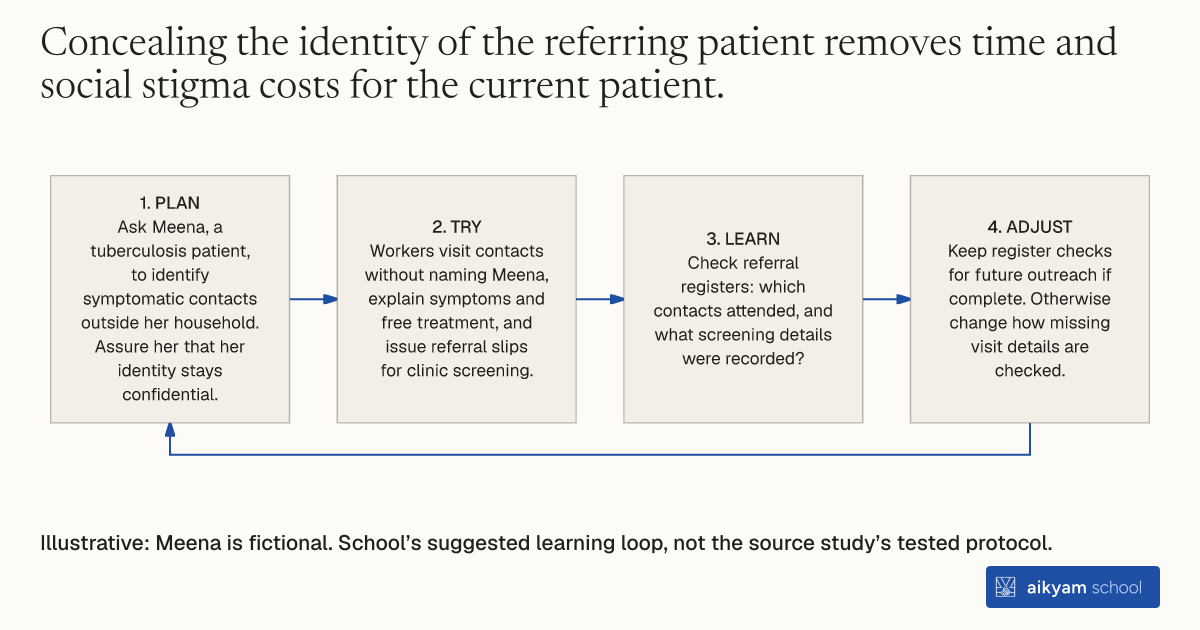
- Plan: Ask Meena, a tuberculosis patient, to identify symptomatic contacts outside her household. Assure her that her identity stays confidential.
- Try: Workers visit contacts without naming Meena, explain symptoms and free treatment, and issue referral slips for clinic screening.
- Learn: Check referral registers: which contacts attended, and what screening details were recorded?
- Adjust: Keep register checks for future outreach if complete. Otherwise change how missing visit details are checked.
Illustrative: Meena is fictional. School’s suggested learning loop, not the source study’s tested protocol.
See source →School's suggested, untested loop: observe screening visits and register entries. This is not a tested clinical protocol.
How
When to use
Current tuberculosis patients know symptomatic acquaintances in their social networks but fear social stigma if their identity is revealed. Anonymous contact tracing allows patient networks to be used for case finding without exposing referrer identities. Community health workers conduct outreach to identified contacts while concealing who referred them.
Dispatch community health workers to visit potential tuberculosis contacts identified by current patients while concealing the identity of the referring patient.
- Health workers ask current tuberculosis patients at health centers to identify symptomatic individuals in their social networks outside their households.
- Health workers assure current patients that their personal identity will remain completely confidential during contact outreach.
- Health workers locate and visit the identified individuals at their home or community locations.
- Health workers present tuberculosis symptom information, local clinic details, and free treatment options without mentioning who provided their name.
- Health workers issue referral cards and encourage symptomatic contacts to attend local clinics for screening.
- Clinic staff conduct clinical screenings and record visit details in referral registers.
Why it works
This protection encourages patients to share network information without fear of social repercussions.
Example
In India, researchers evaluated anonymous health worker contact tracing across Operation ASHA centers in 10 cities, finding that keeping referrer identities concealed carried no stigma costs for current patients but health worker outreach was 2.5 to 3.5 times more expensive than peer outreach.
About the study
Participants
3,176 urban tuberculosis patients across 122 Operation ASHA centers in 10 Indian cities.
Study Design
Randomized controlled trial comparing anonymous health worker contact tracing against identified health worker contact tracing and peer outreach.
Results
Anonymous health worker contact tracing eliminated stigma costs for patients, but health worker outreach was overall 2.5 to 3.5 times more expensive than direct peer outreach.