Try, learn and adjust
Check anonymous referrals reach screening
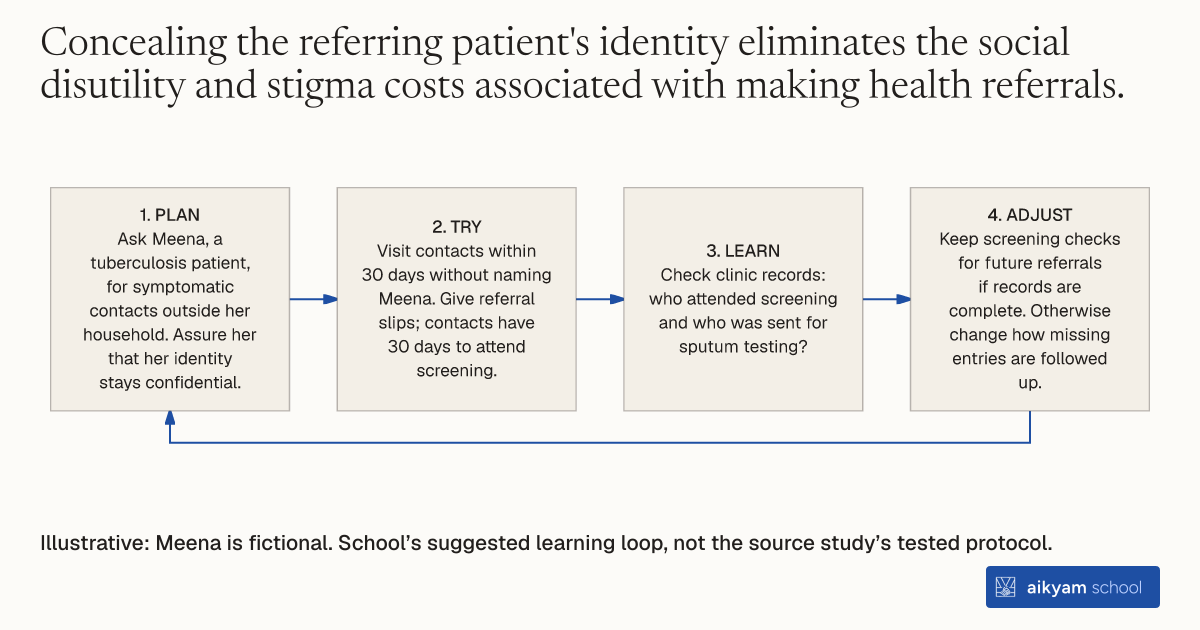
- Plan: Ask Meena, a tuberculosis patient, for symptomatic contacts outside her household. Assure her that her identity stays confidential.
- Try: Visit contacts within 30 days without naming Meena. Give referral slips; contacts have 30 days to attend screening.
- Learn: Check clinic records: who attended screening and who was sent for sputum testing?
- Adjust: Keep screening checks for future referrals if records are complete. Otherwise change how missing entries are followed up.
Illustrative: Meena is fictional. School’s suggested learning loop, not the source study’s tested protocol.
See source →School's suggested, untested loop: observe screening attendance and testing referrals. This is not a tested clinical protocol.
How
When to use
Underdetection of infectious diseases like tuberculosis leaves individuals untreated because health workers cannot easily identify social contacts outside immediate households. Tuberculosis patients may fear disclosure of their diagnosis or social backlash from naming peers. This method deploys health workers for contact tracing while protecting patient confidentiality to reduce social disutility.
Collect contact details of symptomatic social contacts from tuberculosis patients and deploy health workers to conduct home visits without revealing the patient's identity.
- Survey enumerators ask current tuberculosis patients at clinics to list names and addresses of symptomatic social contacts outside their immediate household.
- Enumerators assure current patients that health workers will keep their identity confidential during contact visits.
- Health workers receive the contact information and visit named contacts at home within 30 days.
- Health workers hand contacts a referral card containing clinic details and symptom information while stating that an unnamed person concerned about their health asked them to visit.
- Referred contacts present their referral cards to counselors at local clinics within 30 days of the health worker's visit.
- Clinic counselors screen prospective patients for symptoms and send symptomatic individuals to government testing centers for sputum diagnostic testing.
Why it works
Professional health workers deliver objective treatment information directly to prospective patients at home.
Example
At Operation ASHA clinics in India, health workers visited contacts named by current patients without disclosing who referred them, which resulted in 0.056 new suspects screened per current patient and identified active cases at a cost of \$302 per case detected.
About the study
Participants
926 tuberculosis patients at Operation ASHA clinics across 10 cities in India.
Study Design
Randomized controlled trial comparing anonymous health worker contact tracing against identified contact tracing, direct peer outreach, and pure control arms.
Results
Anonymous contact tracing resulted in 0.056 new suspects screened, 0.049 tests recommended, 0.043 tested, and 0.005 active tuberculosis cases identified per current patient, costing \$71 per suspect screened and \$302 per active case detected.