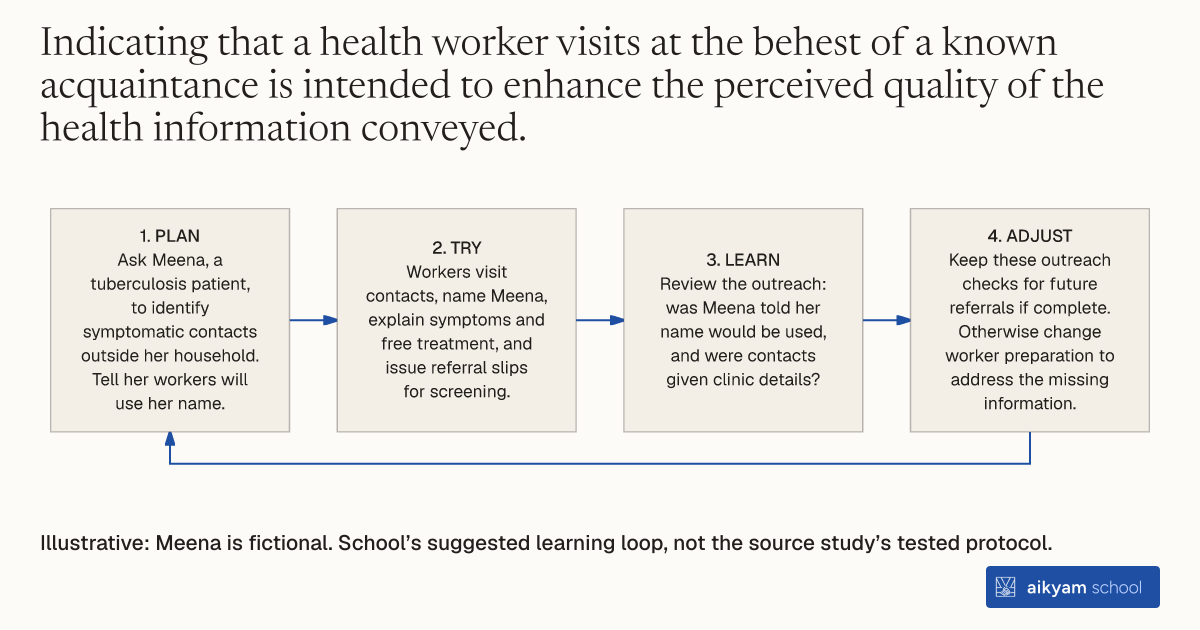
Try, learn and adjust
Check outreach uses the disclosed referral arrangement
- Plan: Ask Meena, a tuberculosis patient, to identify symptomatic contacts outside her household. Tell her workers will use her name.
- Try: Workers visit contacts, name Meena, explain symptoms and free treatment, and issue referral slips for screening.
- Learn: Review the outreach: was Meena told her name would be used, and were contacts given clinic details?
- Adjust: Keep these outreach checks for future referrals if complete. Otherwise change worker preparation to address the missing information.
Illustrative: Meena is fictional. School’s suggested learning loop, not the source study’s tested protocol.
See source →School's suggested, untested loop: observe identity disclosure arrangements and clinic information. This is not a tested clinical protocol.
How
When to use
Tuberculosis detection programs in high-burden urban settings need to reach symptomatic contacts identified by current patients. Direct peer outreach can impose time and social stigma costs on patients. Health programs send community health workers to visit these contacts while explicitly mentioning the referring patient's name to establish credibility.
Send trained community health workers to visit potential tuberculosis contacts identified by current patients, explicitly naming the referring patient during outreach.
- Health workers ask current tuberculosis patients at health centers to identify symptomatic contacts in their social networks outside their households.
- Health workers inform current patients that their names will be disclosed during outreach visits.
- Health workers locate and visit the identified contacts at home or in the community.
- Health workers state that they are visiting at the specific behest of the named current patient.
- Health workers convey tuberculosis symptom information, clinic locations, and free treatment details.
- Health workers issue referral cards and direct symptomatic individuals to local centers for screening.
Example
In India, researchers tested identified health worker contact tracing across Operation ASHA centers in 10 cities, finding that health worker outreach was 2.5 to 3.5 times more expensive than peer outreach.
About the study
Participants
3,176 urban tuberculosis patients across 122 Operation ASHA centers in 10 Indian cities.
Study Design
Randomized controlled trial comparing identified health worker contact tracing against anonymous health worker tracing and direct peer outreach.
Results
Divulging the referrer's identity had no additional impact compared to anonymous health worker outreach, and health worker contact tracing was 2.5 to 3.5 times more expensive than peer outreach.