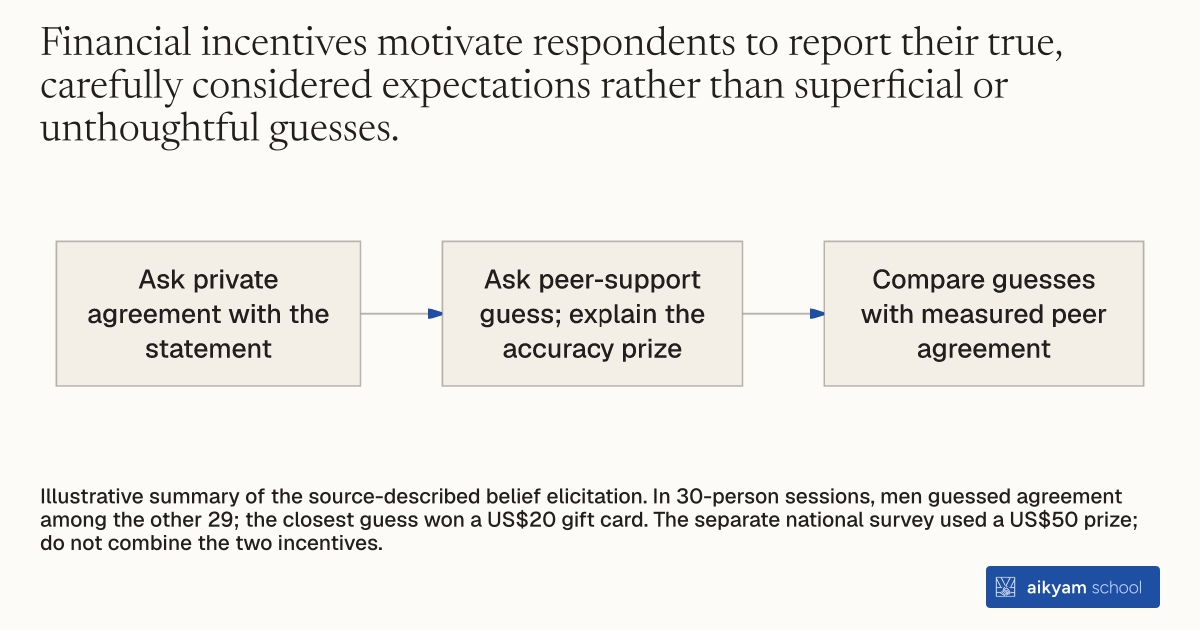
Research steps
Compare rewarded guesses with private support
- Ask private agreement with the statement
- Ask peer-support guess; explain the accuracy prize
- Compare guesses with measured peer agreement
Illustrative summary of the source-described belief elicitation. In 30-person sessions, men guessed agreement among the other 29; the closest guess won a US$20 gift card. The separate national survey used a US$50 prize; do not combine the two incentives.
See source →How
When to use
Situations involving potential misperception of social norms require accurately measuring what individuals believe their peers think. Relying on simple, unincentivized survey questions risks inaccurate or careless answers. Financial rewards for accurate guesses incentivize respondents to carefully consider and reveal their true beliefs about peer preferences.
Elicit accurate beliefs about peer preferences by offering monetary rewards to respondents for correct predictions.
- Administrator presents respondents with a normative statement about a social behavior or policy.
- Participant reports their own private agreement or disagreement in an anonymous survey interface.
- Administrator asks participant to estimate how many other session or survey participants agreed with the statement.
- Administrator informs participant that the individual with the most accurate guess will receive a monetary prize.
- Researcher tabulates responses and calculates the wedge between individual guesses and actual peer support rates.
Why it works
This allows researchers to isolate whether behavioral constraints stem from true societal opposition or misperceived peer opinions.
Example
In Riyadh, Saudi Arabia, 500 married men estimated how many of the 29 other participants in their 30-person session supported women working outside the home, with the top guesser offered a 20 USD gift card code. While 87% privately supported female employment, 72% underestimated peer support, guessing on average that only 63% agreed.
About the study
Participants
500 married Saudi males aged 18 to 35 in 17 neighborhood sessions in Riyadh, plus 1,460 married Saudi males in a national online survey.
Study Design
Survey elicitation with individual financial incentives (20 USD gift card for closest guess in 30-person sessions; 50 USD gift card in the national survey) comparing guessed peer agreement against actual session or national agreement.
Results
In session groups, 72% strictly underestimated support, with an average perception wedge of 24 percentage points (guessing 63% vs 87% actual). In the national survey, 92% of men underestimated support, with an average wedge of 25 percentage points.