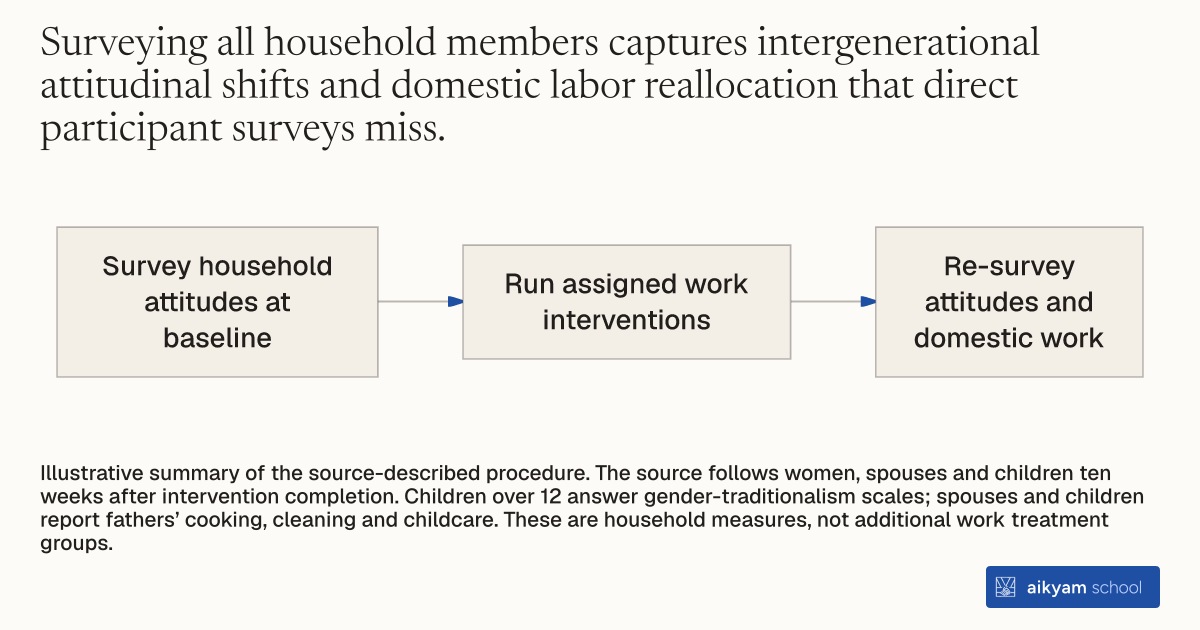
Research steps
Track gender attitudes across the household
- Survey household attitudes at baseline
- Run assigned work interventions
- Re-survey attitudes and domestic work
Illustrative summary of the source-described procedure. The source follows women, spouses and children ten weeks after intervention completion. Children over 12 answer gender-traditionalism scales; spouses and children report fathers’ cooking, cleaning and childcare. These are household measures, not additional work treatment groups.
See source →How
When to use
Evaluating whether female employment interventions create broader cultural shifts within families requires tracking attitudes across multiple household members over time. Traditional evaluations only survey the worker, missing spillover effects on spouses and children. This method serves researchers and evaluators measuring household gender norm dynamics.
Survey participating women, their spouses, and adolescent children across multiple time points to measure shifts in gender traditionalism and domestic task distribution.
- Survey managers administer baseline questionnaires to female participants, male spouses, and older children regarding gender traditionalism indices.
- Evaluators execute the employment intervention phase with female participants across assigned work treatment groups.
- Survey teams return ten weeks after intervention completion to re-survey female participants on gender traditionalism and job acceptance.
- Survey teams interview adolescent children over 12 years old using standardized gender traditionalism scales.
- Survey teams interview male spouses and children regarding paternal contributions to cooking, cleaning, and childcare duties.
Why it works
Longitudinal tracking reveals whether normative changes persist beyond the initial work intervention.
Example
In Kolkata, West Bengal, India, researchers surveyed 1,670 households including female gig workers, male spouses, and children over 12 ten weeks post-intervention, finding that assignment to flexible work reduced maternal and child gender traditionalism and increased paternal domestic help by 9 percentage points.
About the study
Participants
1,670 households (including participating women, male spouses, and children over 12) across rural, peri-urban, and urban Kolkata, West Bengal, India.
Study Design
Longitudinal randomized controlled survey conducted 10 weeks post-intervention measuring gender traditionalism indices and domestic labor allocation across female work treatment arms.
Results
Maternal gender traditionalism decreased by 0.05 standard deviations, children over 12 became 0.1 standard deviations less traditional, and fathers were 9 percentage points (16%) more likely to help with cooking, cleaning, and childcare compared to 58% in the control group.