Research steps
Randomise cash transfer timing by centre
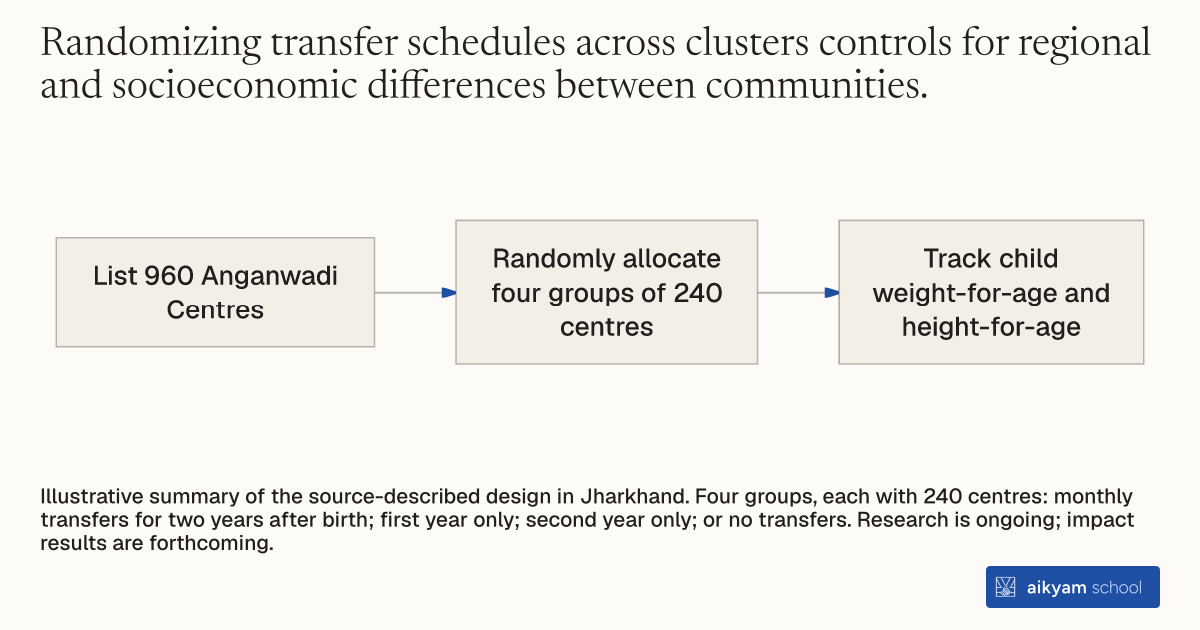
- List 960 Anganwadi Centres
- Randomly allocate four groups of 240 centres
- Track child weight-for-age and height-for-age
Illustrative summary of the source-described design in Jharkhand. Four groups, each with 240 centres: monthly transfers for two years after birth; first year only; second year only; or no transfers. Research is ongoing; impact results are forthcoming.
See source →How
When to use
In social protection and child nutrition initiatives, policymakers often do not know the optimal timing or duration for delivering financial support to pregnant women and lactating mothers. Evaluating different transfer schedules helps determine when cash assistance yields the greatest impact on early childhood development. This method assigns community health centers to distinct transfer duration arms to identify the most effective intervention window.
Randomly divide community health centers into distinct treatment arms that vary the timing and duration of cash transfers provided to mothers.
- Identify and list 960 Anganwadi Centers across the target region.
- Randomly assign 240 centers to a group where eligible mothers receive monthly cash transfers for two years after child birth.
- Randomly assign 240 centers to a group where mothers receive monthly cash transfers for the first year of the child's life.
- Randomly assign 240 centers to a group where mothers receive monthly cash transfers for the second year of the child's life.
- Randomly assign 240 centers to a comparison group where mothers receive no cash transfers.
- Track child weight-for-age and height-for-age across all groups to assess the optimal transfer timing and duration.
Why it works
This design allows researchers to evaluate the optimal timing and duration of cash transfers in improving child development outcomes.
Example
In Jharkhand, researchers randomly assigned 960 Anganwadi Centers into four groups of 240 centers each to receive monthly transfers for two years post-birth, the first year only, the second year only, or no transfers as a comparison group.
About the study
Participants
Pregnant women and lactating mothers across 960 Anganwadi Centers in rural Jharkhand, India, where 43 percent of children under five years old are stunted.
Study Design
Randomized controlled trial dividing 960 Anganwadi Centers into four equal groups of 240 centers each to evaluate different timing and duration windows for unconditional cash transfers.
Results
Research is ongoing and final impact results are forthcoming; baseline data showed 43 percent of children under five are stunted and 42 percent are underweight in Jharkhand.